


Podcast Clip Ignites Debate on Bitcoin’s Origins and CIA Links
We have always followed the principles of transparency and clear information. Some of our content includes affiliate links, and we may earn a small commission through these partnerships. These partnerships do not influence our editorial independence or opinion. By using our site, you accept our privacy policy and terms and conditions.


A Web3 and NFT expert, Elena focuses on the evolution of digital art and blockchain gaming for CryptoWinx. She combines technical expertise with a deep…
Cryptocurrency is a high-risk asset class, and investing carries significant risk, including the potential loss of some or all of your investment. The information on this website is provided for informational and educational purposes only and does not constitute financial, investment, or gambling advice. Cryptowinx does not endorse any specific exchange or gaming platform. For more details, please read our terms and full disclaimer.
Cryptowinx navigates the digital asset universe with a dynamic, forward-looking vision. Throughout our evolution, we have followed every market cycle, from vertical rises to corrections, always remaining a solid point of reference for our community. Our team is made up of industry experts and analysts who experience the blockchain ecosystem daily: we constantly monitor Bitcoin’s stability, study the expansion of the Ethereum ecosystem, and analyze the new frontiers of crypto casinos. We are committed to absolute editorial integrity, separating the signal from the noise through rigorous fact-checking and multi-perspective news analysis. In a landscape where innovations emerge in moments, our mission is to simplify complex concepts and offer transparency into what is established and what is still experimental.
Learn more Cryptowinx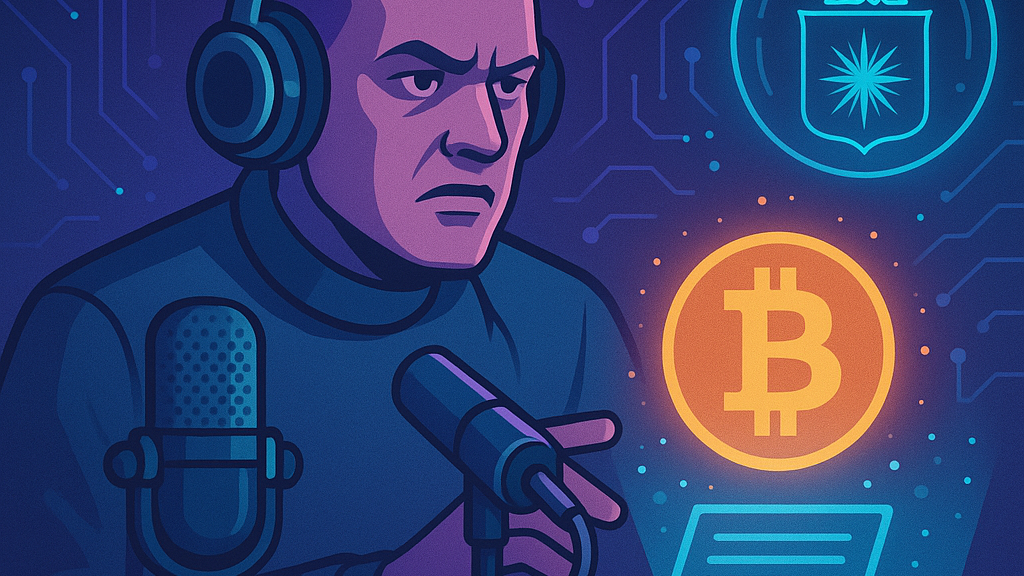
A recent podcast excerpt featuring Jack Neel and commentator Jiang Xueqin has ignited discussions across social media platforms, reigniting the controversial theory that Bitcoin was developed under the auspices of the CIA. This discussion unfolded widely on platforms such as X and TikTok, with the clip from Episode 86 of the Jack Neel Podcast amassing significant attention.
The four-minute segment showcases Jiang, who is a Chinese-Canadian history teacher and operates the YouTube channel Predictive History, elaborating on his belief that Bitcoin serves as a tool for surveillance created by the American intelligence community. His assertions, although lacking empirical evidence, have captured the imagination of many and prompted further exploration into the origins of the cryptocurrency.

Jiang’s approach employs game theory to frame his argument. He poses fundamental questions regarding the technical capabilities required to create Bitcoin, the beneficiaries of its transparent ledger, and the motives behind offering such a system for free. His conclusions consistently implicate high-profile agencies like DARPA, the NSA, and the CIA.
During the podcast, Jiang stresses that analyzing the situation through game theory ultimately leads one to consider the deep state’s involvement, particularly highlighting the CIA’s possible role. He references DARPA’s historical engagement in developing the ARPANET, the predecessor to the internet, as a demonstration of how military entities could evolve into creators of systems appearing to be civilian in nature.
Jiang doesn’t stop there; he suggests that the Winklevoss twins’ investment in Bitcoin post-Facebook settlement hints at their insider knowledge of the cryptocurrency’s inception and relevance. While Jack Neel, the host, laughs and nods along, he does not challenge Jiang’s claims throughout the segment.
Since forecasting Donald Trump’s potential electoral victory and a military confrontation between the U.S. and Iran, Jiang has gained a substantial following, reaching over 2.3 million subscribers on YouTube by April 2026. His engaging delivery and commentary on geopolitical issues have made him a sought-after figure in various media appearances.

Despite the viral spread of Jiang’s ideas, many critics have pointed out weaknesses in his theory. They note that Bitcoin’s foundational design, as outlined in its 2008 white paper, aims to eliminate the need for trusted intermediaries, which is contrary to a premise suggesting a state-sponsored surveillance initiative. Additionally, the transparency of Bitcoin’s code and its open-source nature contradict Jiang’s notions of it being a covert intelligence operation.
Further scrutiny has emerged through online rebuttals, including a popular video critiquing Jiang’s understanding of Bitcoin fundamentals. Critics assert that the historical context of Bitcoin’s pioneers, such as Hal Finney and Wei Dai, predates any known U.S. government interest in digital currency, challenging Jiang’s narrative.
As the conversation surrounding Jiang’s controversial hypothesis gains momentum, it raises critical questions about the intersection of technology, finance, and state power. His claims not only reflect a broader skepticism about the motivations behind cryptocurrencies but also underscore an ongoing fascination with the implications of speculative theories in the evolving digital economy.
Leave the reaction
Elena Rodriguez











Commentaries
Add your comment
Fill in necessary fields and publish