


Bitcoin Remains Resilient Amid Middle East Turmoil
We have always followed the principles of transparency and clear information. Some of our content includes affiliate links, and we may earn a small commission through these partnerships. These partnerships do not influence our editorial independence or opinion. By using our site, you accept our privacy policy and terms and conditions.


A presale and tokenomics specialist, Sofia evaluates new crypto projects with the analytical rigor of her Bocconi background. Having reviewed over 200 launches, she excels…
Cryptocurrency is a high-risk asset class, and investing carries significant risk, including the potential loss of some or all of your investment. The information on this website is provided for informational and educational purposes only and does not constitute financial, investment, or gambling advice. Cryptowinx does not endorse any specific exchange or gaming platform. For more details, please read our terms and full disclaimer.
Cryptowinx navigates the digital asset universe with a dynamic, forward-looking vision. Throughout our evolution, we have followed every market cycle, from vertical rises to corrections, always remaining a solid point of reference for our community. Our team is made up of industry experts and analysts who experience the blockchain ecosystem daily: we constantly monitor Bitcoin’s stability, study the expansion of the Ethereum ecosystem, and analyze the new frontiers of crypto casinos. We are committed to absolute editorial integrity, separating the signal from the noise through rigorous fact-checking and multi-perspective news analysis. In a landscape where innovations emerge in moments, our mission is to simplify complex concepts and offer transparency into what is established and what is still experimental.
Learn more Cryptowinx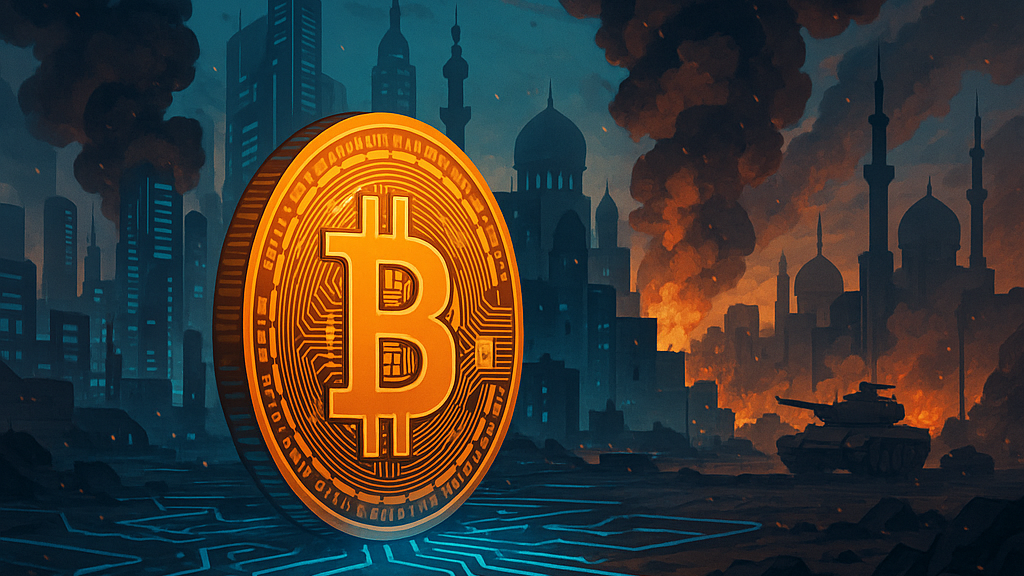
As conflict intensifies in the Middle East, with escalating tensions and rising oil prices, Bitcoin has shown remarkable stability, maintaining a price above $66,000. This resilience amidst market anxiety has drawn the attention of financial analysts.
Typically, the behavior of short-term holders—those who have recently acquired Bitcoin and are likely to sell quickly in times of uncertainty—becomes crucial during market upheavals. However, according to insights from the on-chain data platform CryptoQuant, this group has remained relatively inactive. When Bitcoin dipped to the $63,000 to $64,000 range recently, there was minimal reaction from these investors, with no large-scale selling or significant transfers to exchanges at a loss.

This starkly contrasts with earlier events this month when short-term holders transferred 89,000 BTC to exchanges at a loss over a single day, signaling panic within the market. Since then, however, loss-driven transfers have decreased, indicating that the recent escalation involving Iran has not triggered a similar wave of fear.
CryptoQuant analyst Moreno stated that the behavior of these short-term investors is critical, as markets often stabilize once the most apprehensive sellers have exited. If the low exchange inflows from these holders persist, it might signal seller fatigue, potentially paving the way for a rebound in prices. Conversely, a spike in such inflows could indicate ongoing selling pressure.
The resilience of Bitcoin during geopolitical crises is not unprecedented. Market analyst Ted Pillows highlighted that Bitcoin has navigated similar storms successfully in the past. During the onset of the Russia-Ukraine conflict in February 2022, Bitcoin initially dropped but then surged by 40%. Following Israel’s attack on Iran in June 2025, Bitcoin experienced a similar pattern, dipping before rallying by 25%.
Following recent US-Israeli military actions against Iran, which reportedly targeted thousands of locations, including strategic military assets, Bitcoin has seen a recent withdrawal in value. It dropped by 3.5% since February 26, reaching $65,540 before bouncing back above the $65,000 mark after a temporary dip to $63,030 on February 28.
Given the magnitude of the ongoing conflict, this limited price fluctuation demonstrates a noteworthy level of stability in the cryptocurrency market. It remains to be seen whether historical patterns will repeat, with Bitcoin rebounding from its current lows as the situation unfolds.
Leave the reaction
Sofia Russo












Commentaries
Add your comment
Fill in necessary fields and publish