


Riot Platforms’ Financial Outlook: Mining to Data Centers by 2030
We have always followed the principles of transparency and clear information. Some of our content includes affiliate links, and we may earn a small commission through these partnerships. These partnerships do not influence our editorial independence or opinion. By using our site, you accept our privacy policy and terms and conditions.


A Senior Altcoin Analyst, Sarah combines on-chain data with a background in venture capital research. With a Master’s in Computer Science, she provides precise evaluations…
Cryptocurrency is a high-risk asset class, and investing carries significant risk, including the potential loss of some or all of your investment. The information on this website is provided for informational and educational purposes only and does not constitute financial, investment, or gambling advice. Cryptowinx does not endorse any specific exchange or gaming platform. For more details, please read our terms and full disclaimer.
Cryptowinx navigates the digital asset universe with a dynamic, forward-looking vision. Throughout our evolution, we have followed every market cycle, from vertical rises to corrections, always remaining a solid point of reference for our community. Our team is made up of industry experts and analysts who experience the blockchain ecosystem daily: we constantly monitor Bitcoin’s stability, study the expansion of the Ethereum ecosystem, and analyze the new frontiers of crypto casinos. We are committed to absolute editorial integrity, separating the signal from the noise through rigorous fact-checking and multi-perspective news analysis. In a landscape where innovations emerge in moments, our mission is to simplify complex concepts and offer transparency into what is established and what is still experimental.
Learn more Cryptowinx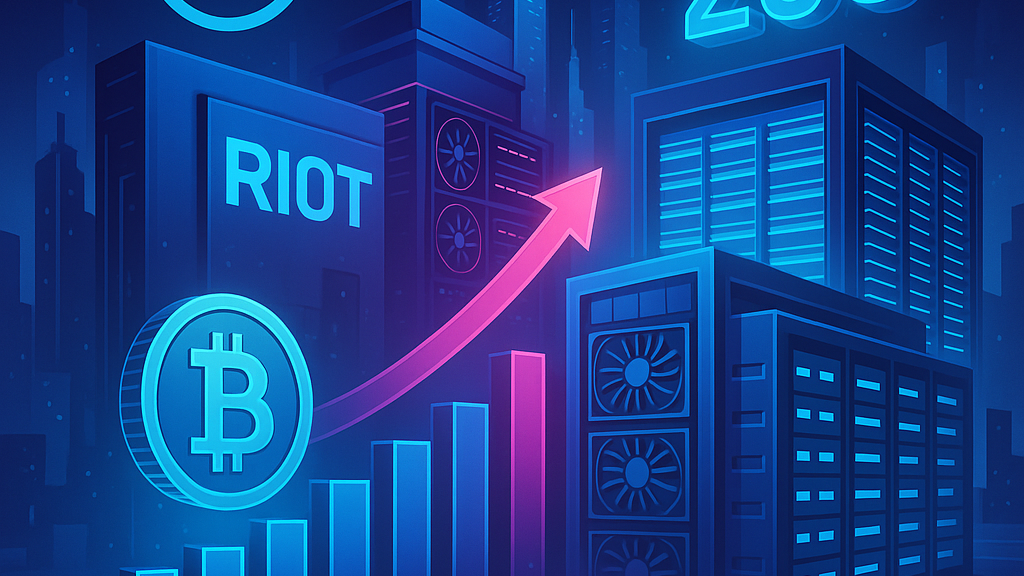
Riot Platforms recently announced a record-breaking financial performance, achieving a remarkable 72% increase in revenue. The company reported that it successfully mined 5,686 bitcoins, alongside the operational launch of its AMD data center lease. Notably, Starboard Value, a key activist investor, has assessed the potential value of Riot’s shift towards artificial intelligence (AI) at an astonishing $21 billion, sharply contrasting with its current market cap of around $6.3 billion.
As of now, the stock trades at approximately $18.24, intensifying discussions surrounding its valuation. The disparity between this figure and Starboard’s optimistic projections highlights the ongoing debate within the investor community. Investors interested in Riot’s trajectory—whether viewing it predominantly as a bitcoin miner or as a burgeoning data center enterprise—must grapple with the reasons behind the market’s apparent undervaluation.

Historically, Riot has undergone significant transformation. Originally established as Riot Blockchain in 2017, the company shifted its focus from biotech to bitcoin mining, sparking a massive stock surge of over 400% shortly after the rebranding. The 2022 transition to Riot Platforms marked a deeper commitment to positioning itself within the data center sector. The strategic pivot seeks to showcase bitcoin mining not merely as speculative finance, but as part of a larger infrastructure solution.
As noted by CEO Jason Les, the company’s current identity emphasizes its role as a leader in data center development fueled by bitcoin. The upcoming Q1 2026 earnings call on April 30 is anticipated to provide more insights into whether this strategic redirection is yielding timely results that could substantiate the stock’s current valuation.
Riot’s fiscal year 2025 results, released on March 2, 2026, contain mixed signals. Revenue soared to an impressive $647.4 million, a surge from $376.7 million in the previous year, while bitcoin mining revenue jumped to $576.3 million due to rising bitcoin prices and enhanced operational capacity. However, the company also reported a staggering net loss of approximately $663 million, reversing its profitable standing from the prior year.
This paradox raises critical questions about Riot’s operational costs, particularly the escalating expenses associated with bitcoin mining. The average cost to mine a single bitcoin surged to $49,645 in FY2025 compared to $32,216 the previous year, attributed largely to increased competition and a growing global network hash rate. Additionally, substantial investments in hardware have driven up depreciation costs.
Despite these challenges, Riot sold 3,778 bitcoins in Q1 2026, outpacing its mining operations—indicating a planned liquidation of its bitcoin reserves to fund infrastructure developments in AI and high-performance computing. This strategic conversion of digital assets into tangible infrastructure raises the stakes for the company’s future trajectory.

Starboard Value’s analysis emphasizes the potential of Riot’s Texas data centers, suggesting that if properly monetized, these facilities could yield significant financial returns, with estimates of more than $1.6 billion in annual EBITDA. This could elevate Riot’s market value dramatically, further underscoring the potential of the newly attempted AI pivot.
The partnership with AMD is crucial; it represents tangible revenue streams for Riot’s data center ambitions. The terms of this 10-year lease set the stage for potential growth in capacity and revenue, effectively validating the company’s new direction. However, the substantial gap between current earnings and future projections illustrates the complexity of transitioning from a mining-centric model to a comprehensive infrastructure player.
Looking ahead, the 2026 financial landscape for Riot Platforms poses varying scenarios. Optimistic projections hinge on several factors including consistent AI data center revenue, additional tenant agreements, and maintaining favorable bitcoin prices. Should these unfold positively, Riot’s stock could see significant appreciation. Conversely, any disappointments could lead to diminished investor sentiment.
As we approach 2030, Riot’s future appears increasingly intertwined with its ability to leverage its physical assets effectively, transitioning from a pure bitcoin mining operation to a robust energy and infrastructure provider capable of supporting growing demands in the AI sector. The potential for substantial growth exists, yet hinges on successful execution and operational performance in the coming years.
Leave the reaction
Sarah Chen







Commentaries
Add your comment
Fill in necessary fields and publish