


Bitcoin’s Future Amidst Wall Street’s Record Highs and Low Confidence
We have always followed the principles of transparency and clear information. Some of our content includes affiliate links, and we may earn a small commission through these partnerships. These partnerships do not influence our editorial independence or opinion. By using our site, you accept our privacy policy and terms and conditions.


James Mitchell combines investment banking with cryptocurrency journalism to analyze the institutional adoption of digital assets. Specializing in ETFs and regulation, he translates complex developments…
Cryptocurrency is a high-risk asset class, and investing carries significant risk, including the potential loss of some or all of your investment. The information on this website is provided for informational and educational purposes only and does not constitute financial, investment, or gambling advice. Cryptowinx does not endorse any specific exchange or gaming platform. For more details, please read our terms and full disclaimer.
Cryptowinx navigates the digital asset universe with a dynamic, forward-looking vision. Throughout our evolution, we have followed every market cycle, from vertical rises to corrections, always remaining a solid point of reference for our community. Our team is made up of industry experts and analysts who experience the blockchain ecosystem daily: we constantly monitor Bitcoin’s stability, study the expansion of the Ethereum ecosystem, and analyze the new frontiers of crypto casinos. We are committed to absolute editorial integrity, separating the signal from the noise through rigorous fact-checking and multi-perspective news analysis. In a landscape where innovations emerge in moments, our mission is to simplify complex concepts and offer transparency into what is established and what is still experimental.
Learn more Cryptowinx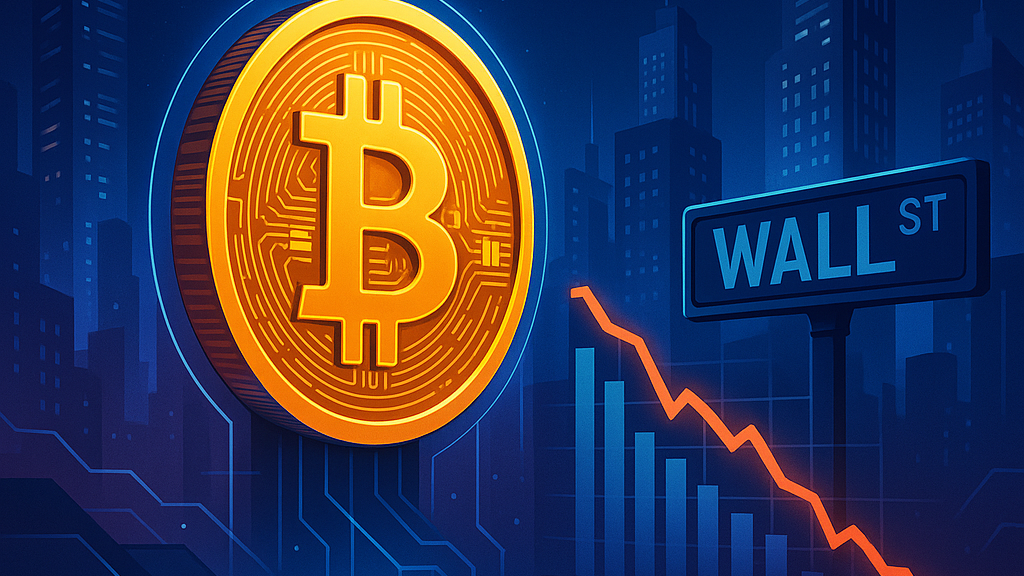
Recent market observations paint a striking contrast between soaring stock prices and plummeting consumer sentiment. The S&P 500 reached a new high of 7,126 on April 17, yet the University of Michigan reported a staggering dip in consumer sentiment, with a preliminary reading of 47.6—the lowest in its history.
This divergence signifies more than just numbers; it reflects an underlying tension that many investors are grappling with. As Wall Street celebrates record gains, American households are expressing deep-seated concerns about economic stability.

At the center of this disparity lies Bitcoin, which seems to be navigating between its reputation as a reliable asset and the realities of its performance. The cryptocurrency finds itself influenced by broader equity market trends and macroeconomic factors, making its future uncertain amid these conflicting signals.
Market analysts have noted that Bitcoin has been highly correlated with the S&P 500, with recent reports highlighting a 30-day correlation coefficient of 0.74—the highest level seen this year. This means that, in the short term, Bitcoin’s price movements are closely tied to stock performance, raising questions about its identity as an asset class.
The current situation is further complicated by consumer feedback from the Michigan survey, which revealed a significant 10.7% decline since March. Respondents pointed to rising prices and deteriorating purchasing conditions resulting in a bleak outlook for the economy. This negativity is compounded by inflation fears; one-year inflation expectations have jumped considerably, indicating stress for individuals at the gas pump and grocery store.
Despite these consumer sentiments, the equity markets have continued to thrive, suggesting a sense of optimism among investors. As the S&P 500 sets new records and the Nasdaq experiences strong bursts of growth, many within the market rationalize the bullish behavior as a response to better-than-expected earnings and geopolitical de-escalation.
This raises an essential question: How will Bitcoin react if the rally in traditional finance proves to be weaker than it appears? Will it absorb the fallout as a speculative asset, or will it retain its integrity as a store of value amidst growing distrust in the financial system?
The answer to this question is critical for Bitcoin, which currently trades around $75,500, representing a modest fluctuation over various timeframes but still significantly below its previous peak. The cryptocurrency’s stabilizing presence is aided by recent ETF inflows, which have increased its institutional appeal. However, while some see this as a consolidation before another surge, others worry that Bitcoin remains deeply connected to the same market forces influencing equity prices.

Employing historical comparisons, analysts often refer back to the dot-com bubble, reminding investors that substantial rallies can occur even within fragile market structures. However, today’s economic landscape differs significantly from that of the late 1990s, as current market leaders are generally backed by solid fundamentals rather than speculative hype.
The concern lies in the concentration of wealth within a small selection of stocks. Recent data illustrate that a handful of companies have driven a significant portion of earnings growth, creating a precarious situation where a setback could have widespread implications for the market. This vulnerability highlights the potential for Bitcoin to potentially face pressure if the broader market declines.
In this complex environment, Bitcoin is likely approaching a critical juncture. It is caught between being perceived as a risk asset that moves in tandem with equities or as a hard asset that gains appeal in times of financial unease. As it stands, the prevailing sentiment treats Bitcoin as a high-risk investment, mirroring the trends in the stock market.
If the gap between Wall Street’s optimism and household fears continues to widen, it could catalyze a reconsideration of Bitcoin’s role. Should traditional markets falter, Bitcoin may indeed reflect the pessimistic sentiment of consumers, impacting its price and identity.
As the situation unfolds, investors must remain vigilant, acknowledging that the current market conditions may not sustain this duality for long. The juxtaposition of record highs in equities against a backdrop of faltering consumer confidence suggests potential challenges ahead for Bitcoin and the broader financial landscape.
Leave the reaction
James Mitchell












Commentaries
Add your comment
Fill in necessary fields and publish