


Bitcoin Miners Sell Record BTC in Q1 2026 Amid Challenges
We have always followed the principles of transparency and clear information. Some of our content includes affiliate links, and we may earn a small commission through these partnerships. These partnerships do not influence our editorial independence or opinion. By using our site, you accept our privacy policy and terms and conditions.


Financial services expert with over three years of experience monitoring cryptocurrency markets and blockchain innovation. Passionate about digital assets and the decentralized future.
Cryptocurrency is a high-risk asset class, and investing carries significant risk, including the potential loss of some or all of your investment. The information on this website is provided for informational and educational purposes only and does not constitute financial, investment, or gambling advice. Cryptowinx does not endorse any specific exchange or gaming platform. For more details, please read our terms and full disclaimer.
Cryptowinx navigates the digital asset universe with a dynamic, forward-looking vision. Throughout our evolution, we have followed every market cycle, from vertical rises to corrections, always remaining a solid point of reference for our community. Our team is made up of industry experts and analysts who experience the blockchain ecosystem daily: we constantly monitor Bitcoin’s stability, study the expansion of the Ethereum ecosystem, and analyze the new frontiers of crypto casinos. We are committed to absolute editorial integrity, separating the signal from the noise through rigorous fact-checking and multi-perspective news analysis. In a landscape where innovations emerge in moments, our mission is to simplify complex concepts and offer transparency into what is established and what is still experimental.
Learn more Cryptowinx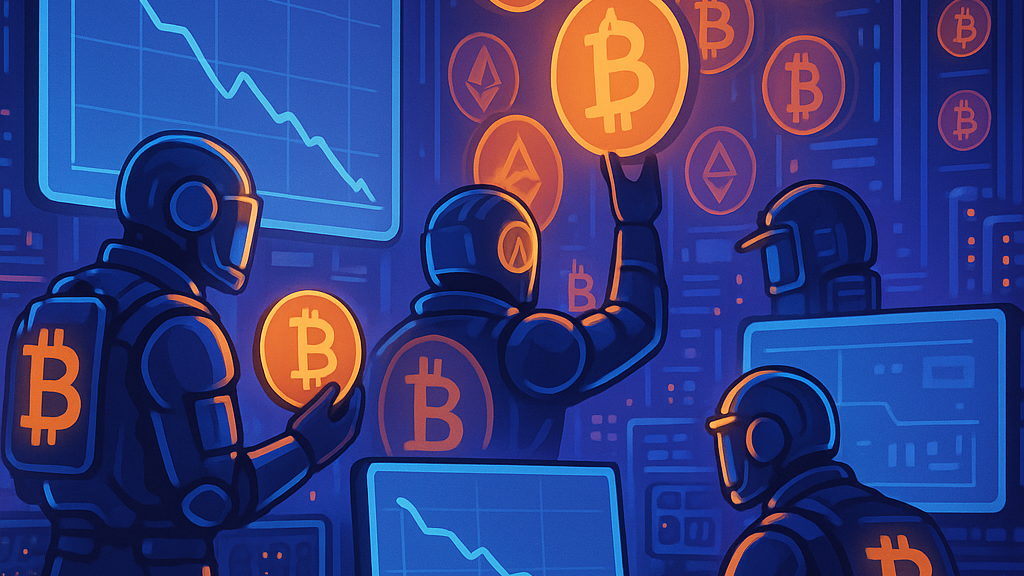
In a significant shift, publicly traded Bitcoin mining firms have sold more Bitcoin in the first quarter of 2026 than they did throughout the entire previous year. This change reflects a challenging environment for the sector as operational costs continue to rise.
According to reports from TheEnergyMag, these organizations, including notable names like MARA, CleanSpark, and Riot, collectively liquidated over 32,000 BTC in just the first three months of 2026. This figure surpasses the total of approximately 20,000 BTC sold during the crypto downturn in Q2 2022, marking a record for miner sales within a single quarter.

The aggressive sell-off coincides with a decline in the hashprice, an essential metric indicating mining profitability, which has dropped to under $35 per petahash per second (PH/s). Presently, the figure hovers around $33 PH/s, creating unprofitability challenges for nearly 20% of miners, especially for those utilizing older equipment.
This dip in hashprice is a troubling trend, having been in decline since July 2025. The combination of increasing competition from higher hashrate levels, lowered block rewards, and adverse macroeconomic factors has forced many miners to reevaluate their strategies.
Long-term trends indicate that total Bitcoin reserves held by miners have decreased since 2023. At the close of 2023, miners collectively held over 1.86 million BTC, but this number has now reduced to approximately 1.8 million BTC.
Many miners routinely sell portions of their reserves to manage operational expenses. However, the dual challenge of falling crypto prices and rising energy costs has compelled some to offload more of their assets than they would typically retain.

Asset management firm CoinShares has noted that unless Bitcoin’s price sees a significant recovery, further capitulation among high-cost mining operators is anticipated in the first half of 2026.
Contrasting with the miners’ selling activities, Bitcoin treasury companies appear to be on a buying spree. Strategy, a prominent Bitcoin treasury firm, has been actively acquiring BTC, even as prices fluctuated around a local high of over $73,000 earlier this week. Michael Saylor, the co-founder of Strategy, recently encouraged a broader vision for acquiring Bitcoin, reinforcing the notion that there are opportunities even amidst market volatility.
This stark contrast between the selling miners and the buying treasury companies highlights the varied strategies within the Bitcoin ecosystem as firms navigate a complex market landscape.
Leave the reaction
Gregory Russell











Commentaries
Add your comment
Fill in necessary fields and publish