


AI’s Growing Influence Challenges Bitcoin Miners’ Stability
We have always followed the principles of transparency and clear information. Some of our content includes affiliate links, and we may earn a small commission through these partnerships. These partnerships do not influence our editorial independence or opinion. By using our site, you accept our privacy policy and terms and conditions.


A Web3 and NFT expert, Elena focuses on the evolution of digital art and blockchain gaming for CryptoWinx. She combines technical expertise with a deep…
Cryptocurrency is a high-risk asset class, and investing carries significant risk, including the potential loss of some or all of your investment. The information on this website is provided for informational and educational purposes only and does not constitute financial, investment, or gambling advice. Cryptowinx does not endorse any specific exchange or gaming platform. For more details, please read our terms and full disclaimer.
Cryptowinx navigates the digital asset universe with a dynamic, forward-looking vision. Throughout our evolution, we have followed every market cycle, from vertical rises to corrections, always remaining a solid point of reference for our community. Our team is made up of industry experts and analysts who experience the blockchain ecosystem daily: we constantly monitor Bitcoin’s stability, study the expansion of the Ethereum ecosystem, and analyze the new frontiers of crypto casinos. We are committed to absolute editorial integrity, separating the signal from the noise through rigorous fact-checking and multi-perspective news analysis. In a landscape where innovations emerge in moments, our mission is to simplify complex concepts and offer transparency into what is established and what is still experimental.
Learn more Cryptowinx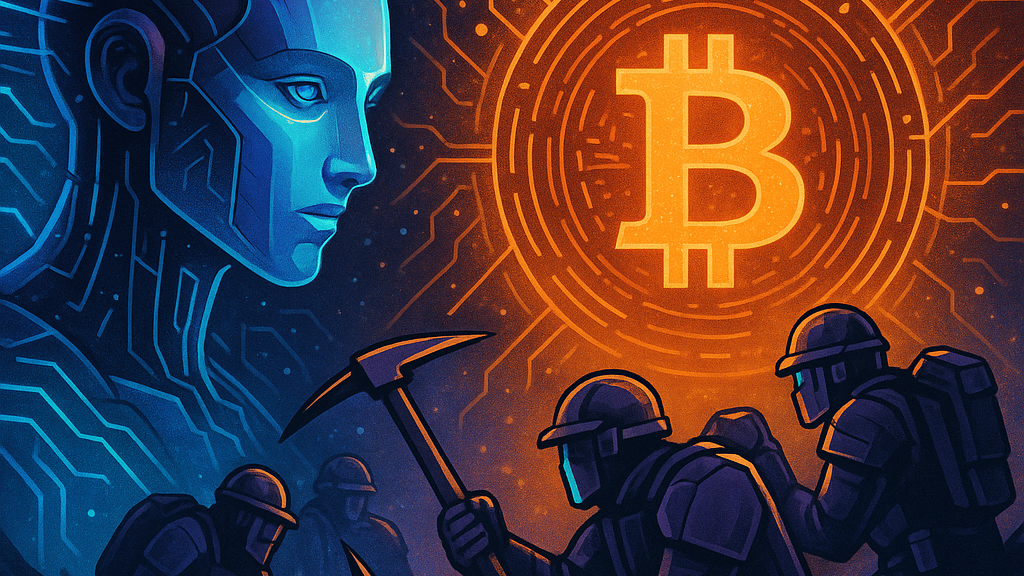
The evolution of technology continually reshapes industries, and in the case of Bitcoin mining, recent trends indicate a significant pivot toward artificial intelligence. Unlike quantum computing, which presents a long-term theoretical threat to cryptography, the immediate challenge comes from AI vying for resources critical to Bitcoin’s operational viability.
At present, Bitcoin is priced at approximately $77,845, reflecting a substantial increase of over 5% in the last 24 hours, alongside notable gains over the past week and month. While mining operations historically yielded substantial returns, the financial landscape appears to be shifting, particularly as energy costs rise.

A recent report from CoinShares highlighted that the average cash cost for Bitcoin production among publicly traded miners surged to nearly $79,995 by the end of 2025. Consequently, around 15% to 20% of global miners may encounter financial difficulties if energy expenses remain elevated. This situation has created a fertile environment for AI, which is aggressively pursuing the same energy, infrastructure, and space that Bitcoin miners have traditionally relied upon.
Evidence of this trend is particularly stark. Bitdeer, a prominent player in the Bitcoin mining sector, recently commenced the removal of Bitcoin mining rigs in Norway to establish an AI data center, indicating a strategic shift in resource allocation. This transition marks a significant moment, as it reflects a tangible move toward repurposing existing mining infrastructure for potentially more lucrative AI applications.
Additionally, Riot Platforms has revealed a new revenue stream from its data center collaboration with AMD, which highlights the increasing importance of AI in generating income. Core Scientific is also on a similar trajectory, with substantial power being allocated to its AI initiatives.
As a result, the mining landscape is beginning to exhibit distinctive stratification. Various miners are taking vastly different approaches to integrate AI into their operations. While some are forming concrete contracts for AI and high-performance computing (HPC), others remain largely focused on Bitcoin.
The financial implications of this shift are profound. CoinShares estimates that AI and HPC contracts within the public mining sector could exceed $70 billion, with projections indicating that miners could derive up to 70% of their revenue from AI by the end of this year, a significant rise from approximately 30% currently.
However, the significant earnings potential from Bitcoin remains robust, especially given the current high market price. Yet, the potential for AI to transform the operational dynamics of mining is evident. Companies with established AI contracts are beginning to rival traditional Bitcoin revenue streams, prompting a re-evaluation of the future of mining operations.
As Bitcoin miners grapple with this new reality, the distinction between those who embrace AI initiatives and those who remain solely committed to Bitcoin may define the competitive landscape of the future. The financial realities of power, resources, and infrastructure demand that miners reassess their business models.
This transitional phase suggests a dual-path future for mining. For those without substantial AI engagements, Bitcoin remains a primary revenue generator. Conversely, miners leveraging premium energy sites for AI services could potentially derive greater financial benefits.
Ultimately, while Bitcoin continues to generate significant revenue, the pressure from AI is reshaping the economic dynamics of the mining sector. This evolution underscores the urgent need for miners to adapt and innovate as they navigate an increasingly complex and competitive landscape.
Leave the reaction
Elena Rodriguez












Commentaries
Add your comment
Fill in necessary fields and publish