


Bitcoin’s Price Volatility Amid US-Iran Negotiation Tensions
We have always followed the principles of transparency and clear information. Some of our content includes affiliate links, and we may earn a small commission through these partnerships. These partnerships do not influence our editorial independence or opinion. By using our site, you accept our privacy policy and terms and conditions.


James Mitchell combines investment banking with cryptocurrency journalism to analyze the institutional adoption of digital assets. Specializing in ETFs and regulation, he translates complex developments…
Cryptocurrency is a high-risk asset class, and investing carries significant risk, including the potential loss of some or all of your investment. The information on this website is provided for informational and educational purposes only and does not constitute financial, investment, or gambling advice. Cryptowinx does not endorse any specific exchange or gaming platform. For more details, please read our terms and full disclaimer.
Cryptowinx navigates the digital asset universe with a dynamic, forward-looking vision. Throughout our evolution, we have followed every market cycle, from vertical rises to corrections, always remaining a solid point of reference for our community. Our team is made up of industry experts and analysts who experience the blockchain ecosystem daily: we constantly monitor Bitcoin’s stability, study the expansion of the Ethereum ecosystem, and analyze the new frontiers of crypto casinos. We are committed to absolute editorial integrity, separating the signal from the noise through rigorous fact-checking and multi-perspective news analysis. In a landscape where innovations emerge in moments, our mission is to simplify complex concepts and offer transparency into what is established and what is still experimental.
Learn more Cryptowinx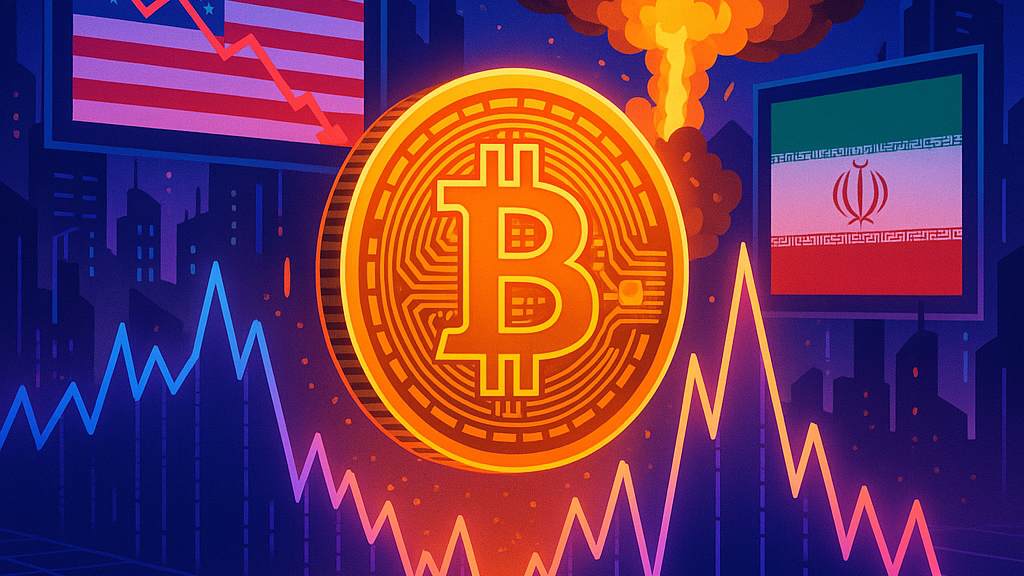
On April 21, a turbulent trading environment engulfed bitcoin as its value oscillated between $75,000 and $77,000, driven by geopolitical tensions centered on U.S.-Iran relations.
In a session that began with bitcoin hovering just below $76,500, prices dipped to $75,600, reflecting the market’s reaction to heightened political rhetoric from both Washington and Tehran. However, optimism arose from reports that U.S. and Iranian officials would meet in Islamabad for crucial negotiations.

This diplomatic development appeared to inject a brief sense of confidence into the cryptocurrency market, prompting a shift in investor sentiment from risk aversion to cautious optimism. The prospect of de-escalation, particularly following a recent U.S. seizure of an Iranian ship, provided a momentary uplift for bitcoin.
As the morning progressed, the cryptocurrency surged to a high of $76,944, propelled by positive momentum in trading volumes. This rally, observed through Bitstamp’s order books, lasted approximately six hours and signaled a potential reversal from earlier bearish trends.
However, that initial enthusiasm quickly faded. Reports uncertain about the Iranian delegation’s attendance dampened the market’s mood, leading to a significant price correction. The uncertainty resulted in a downward shift, and by 1:20 p.m., bitcoin had fallen to an intraday low of $75,085.
By late afternoon, bitcoin managed a slight recovery, regaining ground above the $75,500 mark. Market participants shifted their focus to the critical psychological threshold of $76,000, an essential level for the asset to invalidate the negative sentiment that defined the trading day.

Despite the slight rebound, bitcoin concluded the day with a decrease of 0.6%, leaving its market capitalization at approximately $1.51 trillion. This decline occurred amidst significant inflows into exchange-traded funds (ETFs) and a noteworthy acquisition by Strategy. The market saw considerable volatility, exceeding 2.61% on the day, resulting in the liquidation of 6,769 traders and a total loss of nearly $97 million in leveraged positions, with shorts contributing to the majority of the liquidations.
While bitcoin exhibited a degree of stability around the $75,500 range, the geopolitical climate, particularly the ongoing U.S.-Iran maritime tensions, illustrates just how closely the cryptocurrency market reacts to global events.
Leave the reaction
James Mitchell












Commentaries
Add your comment
Fill in necessary fields and publish