


Zcash Price Forecast: Insights for 2026, 2027, and 2030
We have always followed the principles of transparency and clear information. Some of our content includes affiliate links, and we may earn a small commission through these partnerships. These partnerships do not influence our editorial independence or opinion. By using our site, you accept our privacy policy and terms and conditions.


A Web3 and NFT expert, Elena focuses on the evolution of digital art and blockchain gaming for CryptoWinx. She combines technical expertise with a deep…
Cryptocurrency is a high-risk asset class, and investing carries significant risk, including the potential loss of some or all of your investment. The information on this website is provided for informational and educational purposes only and does not constitute financial, investment, or gambling advice. Cryptowinx does not endorse any specific exchange or gaming platform. For more details, please read our terms and full disclaimer.
Cryptowinx navigates the digital asset universe with a dynamic, forward-looking vision. Throughout our evolution, we have followed every market cycle, from vertical rises to corrections, always remaining a solid point of reference for our community. Our team is made up of industry experts and analysts who experience the blockchain ecosystem daily: we constantly monitor Bitcoin’s stability, study the expansion of the Ethereum ecosystem, and analyze the new frontiers of crypto casinos. We are committed to absolute editorial integrity, separating the signal from the noise through rigorous fact-checking and multi-perspective news analysis. In a landscape where innovations emerge in moments, our mission is to simplify complex concepts and offer transparency into what is established and what is still experimental.
Learn more Cryptowinx
The record high for Zcash (ZEC) stands at an astonishing $5,941.80, a number that still resonates in the cryptocurrency community.
Since its launch on October 29, 2016, Zcash made headlines with a trading debut price close to $6,000. The initial excitement stemmed from a combination of limited availability in its early stages and the anticipation that Zcash could provide industry-leading privacy features, distinguishing it from Bitcoin. However, this peak has yet to be revisited in the ensuing nine years.

Currently, ZEC is trading around $255, reflecting a staggering 96% drop from its all-time high, which was largely deemed an unsustainable price spike. A more relevant historical benchmark occurred in November 2025 when ZEC reached approximately $748, only to fall to around $220 in early 2026 before making a slight recovery. Furthermore, the all-time low was recorded at $15.87 in July 2024, during which time Zcash was at risk of being overlooked entirely within the cryptocurrency market. Yet now, with a market capitalization of approximately $4.2 to $4.3 billion, ZEC appears to be gaining renewed interest.
The potential for a significant price rally for ZEC hinges upon various factors, including developments within the privacy coin sector, specific technological advancements related to Zcash, and the impacts of upcoming events such as the Crosslink implementation, the next halving, and evolving regulatory measures in the EU.
Disclaimer: This article serves informational purposes only and does not constitute investment advice. ZEC carries inherent volatility; thorough research is essential.
Zcash was established to tackle a fundamental limitation faced by Bitcoin and numerous other cryptocurrencies: while these coins offer pseudonymity, true privacy is elusive.
Public ledgers record every Bitcoin transaction permanently. The identifiers visible to the public are merely cryptocurrency addresses, devoid of any personal details. However, the sophistication of blockchain analytics has reached a level where it is now commonplace for law enforcement and data analysis firms to trace these addresses back to real-world identities. Consequently, Bitcoin’s claimed privacy is practically non-existent, particularly for users engaging with exchanges that mandate Know Your Customer (KYC) compliance.
Zcash addresses this challenge through zk-SNARKs, which allow for the validation of transactions without disclosing transaction specifics. This means that information about senders, receivers, and amounts remains undisclosed, with the blockchain only reflecting that a transaction has occurred in alignment with the established regulations.
This method ensures security at the protocol level, rather than relying on voluntary mixing techniques or services like CoinJoin. Privacy advocates have praised Zcash’s architecture, which was developed by expert cryptographers rather than tacked onto existing structures: it has its roots in academic research, including the Zerocash paper written by noted figures like Eli Ben-Sasson.
However, Zcash has faced challenges, including recent team shakeups within the Electric Coin Company. Early 2026 saw the closure of a long-standing investigation into the nonprofit by the U.S. Securities and Exchange Commission (SEC), which concluded without any recommended enforcement actions. While this news did not significantly impact market performance—given the anticipation surrounding this outcome—it lifted some of the regulatory uncertainties surrounding Zcash’s privacy model, which is designed as opt-in rather than mandatory.

The beginning of 2026 also marked a critical transition period for Zcash, following a team upheaval that led to the exit of key members toward a new venture. Despite this upheaval, the ecosystem remained intact, with the Zcash Open Development Lab securing over $25 million in funding from prominent investors, signaling confidence in Zcash’s future.
Moreover, an important vulnerability in the software was disclosed and promptly addressed, showcasing the project’s governance and risk management capabilities. As Zcash evolves, plans for a new institutional mining pool have emerged, further establishing ZEC’s status as a viable asset.
As Zcash navigates its technological transition and potential halving set for November 2028, the performance of ZEC in the coming years will be shaped by the adoption of initiatives like Crosslink and Zcash Shielded Assets (ZSAs), as well as the ongoing regulatory landscape regarding privacy coins.
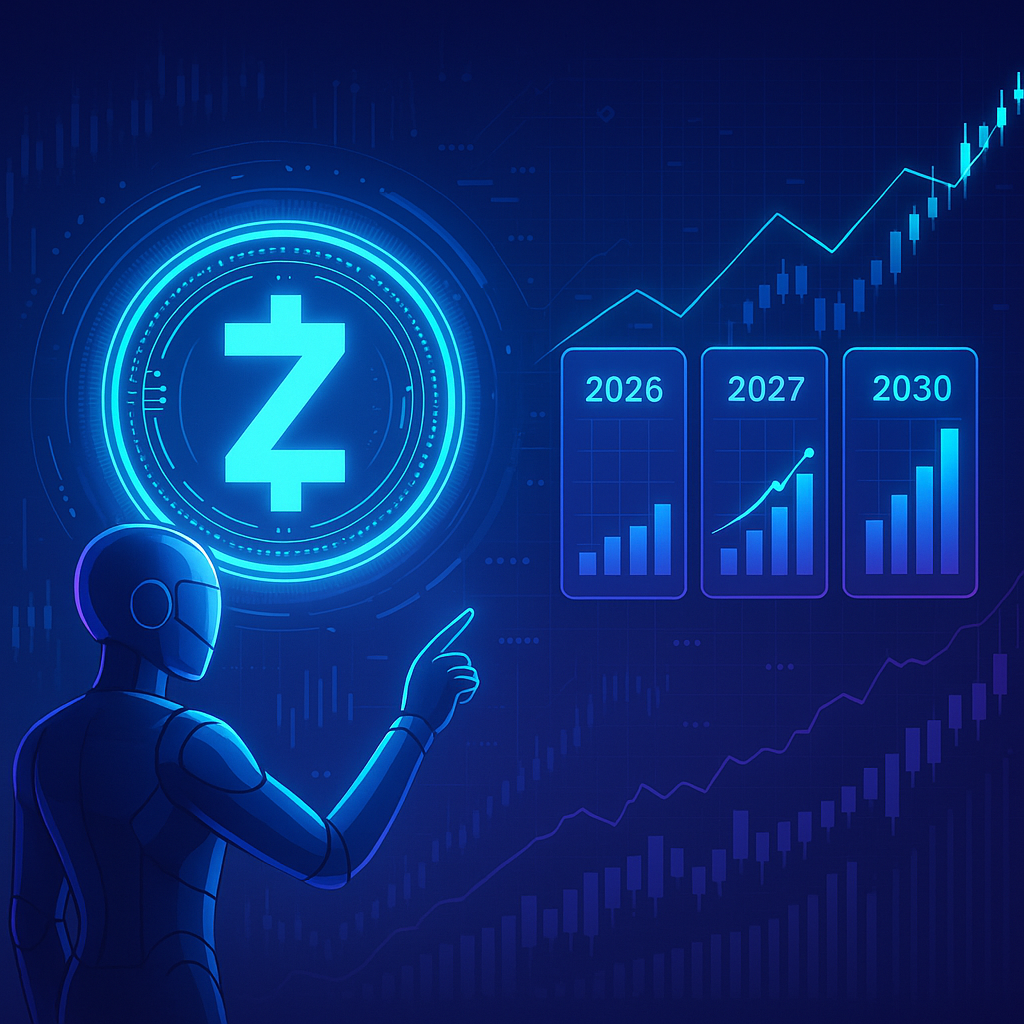
Looking ahead to 2026, projections for ZEC’s price are broad, reflecting the uncertainty that characterizes the cryptocurrency market. Conservative estimates suggest it could range between $231 and $361, while more optimistic forecasts could see values reaching upwards of $850 if significant developments materialize.
By 2027, major milestones, including the potential activation of Crosslink and impending regulatory decisions, will further influence ZEC’s economic dynamics, with predictions ranging significantly across the spectrum.
As we approach 2030, the implications of decreased block rewards following the upcoming halving may ignite increased scarcity, with several analysts suggesting significant price potential. Still, regulatory hurdles remain a substantial risk, underscoring the need for Zcash to solidify its position as a privacy-focused currency. The landscape for ZEC in the next years is complex yet full of potential, depending heavily on technological advancements and regulatory developments.
In summary, although ZEC’s past all-time high is unlikely to be a realistic target, achieving a return to previous peaks or even breaking new ground could be within reach should the upcoming changes yield favorable circumstances for Zcash.
Leave the reaction
Elena Rodriguez










Commentaries
Add your comment
Fill in necessary fields and publish