


Expert Warns Lightning Network Vulnerable to Quantum Threats
We have always followed the principles of transparency and clear information. Some of our content includes affiliate links, and we may earn a small commission through these partnerships. These partnerships do not influence our editorial independence or opinion. By using our site, you accept our privacy policy and terms and conditions.


A Web3 and NFT expert, Elena focuses on the evolution of digital art and blockchain gaming for CryptoWinx. She combines technical expertise with a deep…
Cryptocurrency is a high-risk asset class, and investing carries significant risk, including the potential loss of some or all of your investment. The information on this website is provided for informational and educational purposes only and does not constitute financial, investment, or gambling advice. Cryptowinx does not endorse any specific exchange or gaming platform. For more details, please read our terms and full disclaimer.
Cryptowinx navigates the digital asset universe with a dynamic, forward-looking vision. Throughout our evolution, we have followed every market cycle, from vertical rises to corrections, always remaining a solid point of reference for our community. Our team is made up of industry experts and analysts who experience the blockchain ecosystem daily: we constantly monitor Bitcoin’s stability, study the expansion of the Ethereum ecosystem, and analyze the new frontiers of crypto casinos. We are committed to absolute editorial integrity, separating the signal from the noise through rigorous fact-checking and multi-perspective news analysis. In a landscape where innovations emerge in moments, our mission is to simplify complex concepts and offer transparency into what is established and what is still experimental.
Learn more Cryptowinx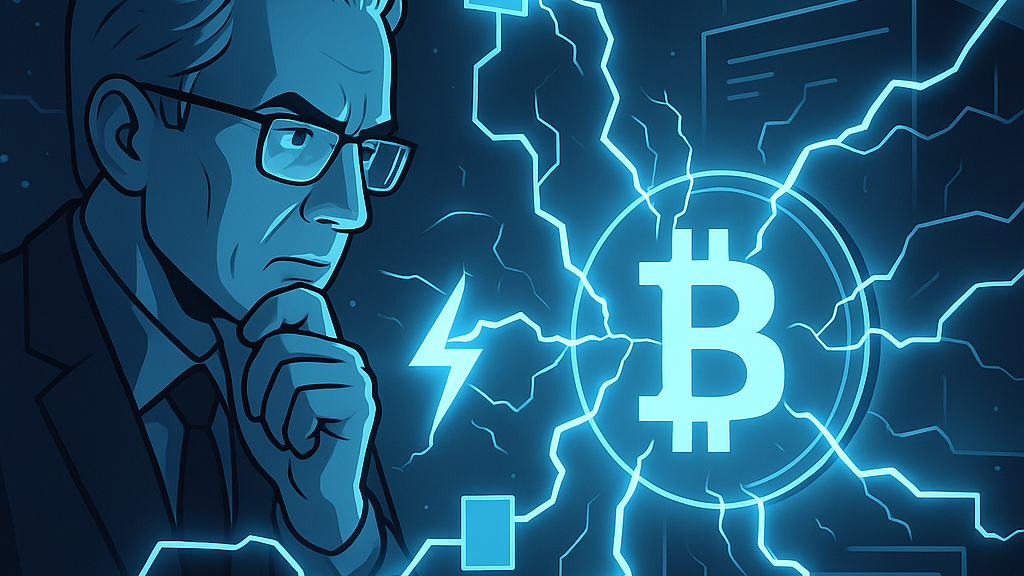
Udi Wertheimer, a prominent crypto analyst and developer focused on Taproot, has raised serious concerns regarding the safety of the Lightning Network in an era dominated by quantum computing. He points out that the fundamental structure of the network poses a significant risk to user funds, leaving them vulnerable in ways that current assumptions cannot address.
As explained by Wertheimer, the critical challenge emerges from the mechanics of public and private keys in cryptocurrency systems. He clarified that traditional cryptographic principles operate under the belief that private keys cannot be inferred from public keys. However, he warns that upcoming quantum machines, termed cryptographically relevant quantum computers (CRQCs), could potentially undermine this premise by rapidly deriving private keys from their public counterparts.

While standard on-chain Bitcoin transactions allow users to minimize risk through practices like avoiding address reuse, Wertheimer argues that such strategies are ineffective within the Lightning Network. The inherent design requires participants to share public keys openly, a necessity that compromises security.
The network operates on payment channels, which function as multi-signature agreements between two entities. To establish and sustain these channels, users must exchange public keys with others, resulting in these keys being exposed and often stored by third-party infrastructures. This lack of control and transparency heightens the risk of exploitation.
Wertheimer notes that if an adversary gains access to a CRQC or obtains public keys through other means, they could derive private keys without user intervention, facilitating the theft of funds. Alarmingly, such an attack does not necessitate the advanced capabilities of speed often theorized about quantum computers; instead, offline exploitation of already accessible public key information would suffice.
The complexity of the situation increases due to the opaque nature of the Lightning Network’s infrastructure. Participants often lack insight into the true control and security of their data as service providers may remain anonymous. According to Wertheimer, standard practices within the Bitcoin community do not sufficiently mitigate this vulnerability, as the necessity for key sharing on the Lightning Network cannot be eliminated.
The developer goes further by characterizing the Lightning Network as being “helplessly broken” in terms of its resilience against quantum threats. He emphasizes that addressing this issue would require substantial changes to Bitcoin’s core protocol to integrate quantum-resistant cryptographic techniques, which have not been implemented thus far.

Until such safeguards are established, funds held within the Lightning Network remain at risk, potentially facing compromise once quantum computing technology reaches a level capable of exploiting these vulnerabilities.
Wertheimer’s warnings come shortly after Google’s research team published a paper highlighting the dangers quantum computing poses to cryptocurrencies. The findings suggest that a powerful quantum machine could breach the private keys of Ethereum’s top wallets in less than nine days, jeopardizing vast amounts of ETH.
In response to the looming quantum threat, Blockstream has revealed its efforts to enhance Bitcoin’s security. The company has initiated the use of post-quantum cryptography within its Liquid sidechain, enabling the use of quantum-resistant signatures for contracts. This addition does not alter Bitcoin’s primary protocol but instead fortifies security at the contract level through Blockstream’s Simplicity smart contract language. The research has also outlined several risks associated with sidechains, such as vulnerabilities in transaction and block signatures and issues linked to cross-chain asset transfers.
Leave the reaction
Elena Rodriguez












Commentaries
Add your comment
Fill in necessary fields and publish