


Dmail Network Announces Service Shutdown on May 15
We have always followed the principles of transparency and clear information. Some of our content includes affiliate links, and we may earn a small commission through these partnerships. These partnerships do not influence our editorial independence or opinion. By using our site, you accept our privacy policy and terms and conditions.


James Mitchell combines investment banking with cryptocurrency journalism to analyze the institutional adoption of digital assets. Specializing in ETFs and regulation, he translates complex developments…
Cryptocurrency is a high-risk asset class, and investing carries significant risk, including the potential loss of some or all of your investment. The information on this website is provided for informational and educational purposes only and does not constitute financial, investment, or gambling advice. Cryptowinx does not endorse any specific exchange or gaming platform. For more details, please read our terms and full disclaimer.
Cryptowinx navigates the digital asset universe with a dynamic, forward-looking vision. Throughout our evolution, we have followed every market cycle, from vertical rises to corrections, always remaining a solid point of reference for our community. Our team is made up of industry experts and analysts who experience the blockchain ecosystem daily: we constantly monitor Bitcoin’s stability, study the expansion of the Ethereum ecosystem, and analyze the new frontiers of crypto casinos. We are committed to absolute editorial integrity, separating the signal from the noise through rigorous fact-checking and multi-perspective news analysis. In a landscape where innovations emerge in moments, our mission is to simplify complex concepts and offer transparency into what is established and what is still experimental.
Learn more Cryptowinx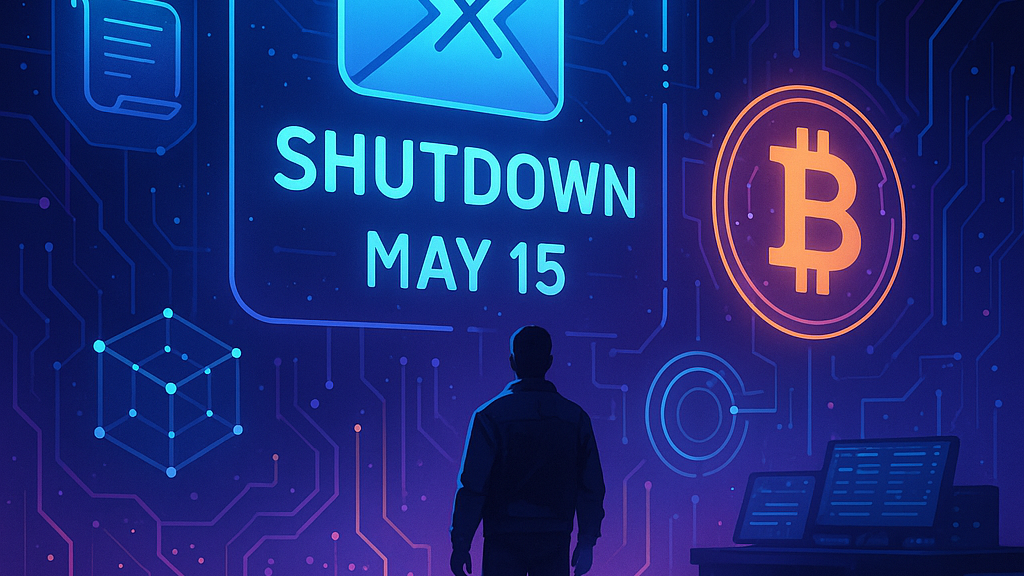
Dmail Network has announced that it will discontinue its operations on May 15, following a challenging five-year tenure. The decentralized email platform has cited escalating infrastructure expenses, unsuccessful fundraising attempts, and inadequate token utility as the primary reasons for its closure.
The company is urging its users to export their data ahead of the shutdown, as all services will become inaccessible after the specified date. This closure signifies a significant shift in the landscape of decentralized communication, as Dmail’s infrastructure may no longer be viable in the current economic climate.

Dmail Network aimed to deliver a wallet-based email solution combined with encrypted messaging and on-chain notifications, positioning itself as part of the Web3 movement. However, the platform ultimately faced insurmountable financial challenges. In January 2025, DappRadar had rated Dmail as the second highest AI DApp, highlighting its engagement with approximately 4.9 million unique active wallets during that month.
The decision to cease operations underscores the difficulty of maintaining a decentralized service dependent on heavy infrastructure while also navigating high operational costs and limited monetization options. Dmail acknowledged that the economics of managing such a platform had become increasingly untenable as the user base expanded, with significant costs associated with bandwidth and storage that strained budgets.
Attempts to implement paid models and explore various monetization strategies were unsuccessful, as the company struggled to identify a business model that resonated with users at a larger scale. Furthermore, adverse market conditions compounded these issues, with the company reporting that numerous funding rounds did not succeed, and some acquisition prospects fell through, leading to a dwindling financial reserve.
The lack of a clear, scalable use case for Dmail’s token also contributed to its decline, as the economic framework failed to create a self-sustaining cycle. Following the announcement of the impending shutdown, the token experienced a drastic drop, hitting an all-time low of $0.0002067, as noted by CoinGecko.

Dmail’s impending closure adds to a growing list of Web3 projects struggling to survive in a demanding market. Other notable platforms, such as DAO tooling service Tally and development firm Balancer Labs, have also recently announced their shutdowns, reflecting broader challenges within the industry.
In summary, Dmail Network’s decision to shut down highlights the significant obstacles facing decentralized projects, particularly in terms of financial sustainability and user engagement. As the landscape continues to evolve, it remains to be seen how other Web3 initiatives will adapt to these ongoing challenges.
Leave the reaction
James Mitchell












Commentaries
Add your comment
Fill in necessary fields and publish