


Criticism Mounts Against Jiang’s CIA Bitcoin Assertions
We have always followed the principles of transparency and clear information. Some of our content includes affiliate links, and we may earn a small commission through these partnerships. These partnerships do not influence our editorial independence or opinion. By using our site, you accept our privacy policy and terms and conditions.


Financial services expert with over three years of experience monitoring cryptocurrency markets and blockchain innovation. Passionate about digital assets and the decentralized future.
Cryptocurrency is a high-risk asset class, and investing carries significant risk, including the potential loss of some or all of your investment. The information on this website is provided for informational and educational purposes only and does not constitute financial, investment, or gambling advice. Cryptowinx does not endorse any specific exchange or gaming platform. For more details, please read our terms and full disclaimer.
Cryptowinx navigates the digital asset universe with a dynamic, forward-looking vision. Throughout our evolution, we have followed every market cycle, from vertical rises to corrections, always remaining a solid point of reference for our community. Our team is made up of industry experts and analysts who experience the blockchain ecosystem daily: we constantly monitor Bitcoin’s stability, study the expansion of the Ethereum ecosystem, and analyze the new frontiers of crypto casinos. We are committed to absolute editorial integrity, separating the signal from the noise through rigorous fact-checking and multi-perspective news analysis. In a landscape where innovations emerge in moments, our mission is to simplify complex concepts and offer transparency into what is established and what is still experimental.
Learn more Cryptowinx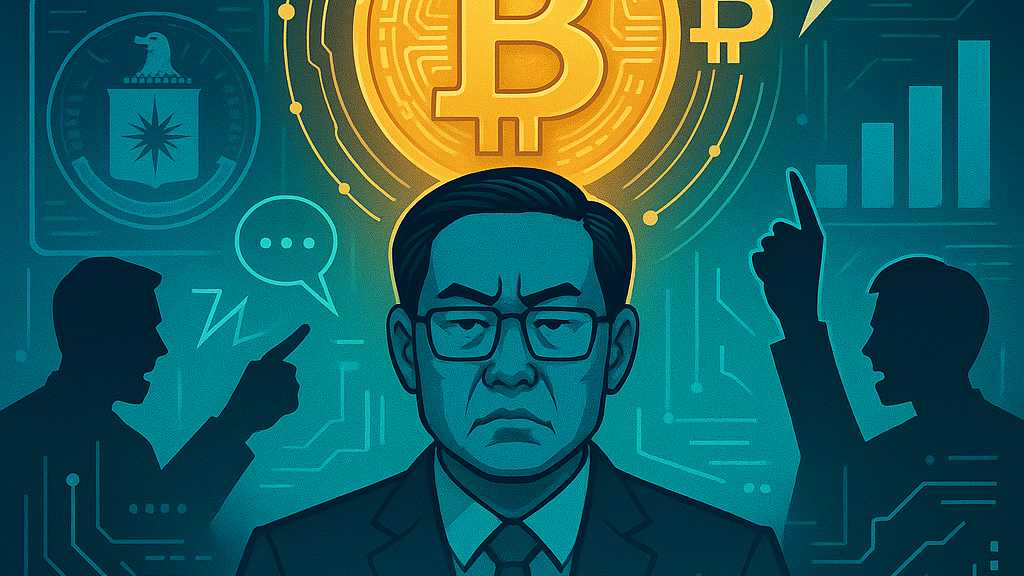
A provocative discussion on the origins of Bitcoin has sparked backlash within the cryptocurrency community after Professor Jiang presented a theory linking the creation of Bitcoin to the CIA during a recent episode of the Jack Neel Podcast.
Jiang, a prominent figure in Beijing with over 2.3 million subscribers on his Predictive History channel, suggested that Bitcoin serves as a tool for deep state surveillance. His comments have ignited a wave of criticism from various sectors of the crypto space.

During the podcast, Jiang raised several inquiries regarding Bitcoin’s development, questioning who possessed the necessary technical skills, who benefits from it, and the implications of its anonymous creator. He argued that, when analyzed through the lens of game theory, the origins point toward an involvement by the American deep state, particularly the CIA.
In his analysis, Jiang posited that blockchain technology might have been conceived by the same entities responsible for developing pivotal technologies like the internet and GPS. He theorized that the CIA could exploit such a system for both surveillance and covert financial operations.
Furthermore, Jiang emphasized the importance of maintaining the anonymity of Bitcoin’s creator to preserve user trust in the system. He warned that if the public believed a government agency had undue influence, it could erode confidence and deter participation.
The podcast generated significant discourse within the community, as many experts challenged Jiang’s assertions about server control. One analyst clarified that Bitcoin operates through tens of thousands of independent nodes worldwide, negating the notion of a central server and a single point of failure.
Critics did not hold back; one prominent voice remarked that Jiang misunderstood the fundamental principles of Bitcoin, suggesting a lack of understanding of its decentralized nature. Another commentator referred to Jiang’s views as indicative of a broader confusion prevalent among those unfamiliar with Bitcoin.

In a related commentary, Bitcoin advocate Jeff Booth suggested that even if the CIA were involved in Bitcoin’s creation, it would not diminish its value or relevance to users today. He noted that ownership of Bitcoin has since transitioned away from its creators.
Debate about Satoshi Nakamoto’s identity continues to captivate interest, with various theories surfacing over the years. The latest speculation, initiated by an extensive investigation from The New York Times, has identified Blockstream CEO Adam Back as a potential candidate, a claim he has firmly dismissed.
In summary, the discourse surrounding Jiang’s controversial theory illustrates the ongoing tensions in the cryptocurrency world, underscoring the importance of understanding Bitcoin’s decentralized framework amid various narratives seeking to explain its origins.
Leave the reaction
Gregory Russell










Commentaries
Add your comment
Fill in necessary fields and publish