


Buffett’s Massive T-Bill Investment Sparks Bitcoin Concerns
We have always followed the principles of transparency and clear information. Some of our content includes affiliate links, and we may earn a small commission through these partnerships. These partnerships do not influence our editorial independence or opinion. By using our site, you accept our privacy policy and terms and conditions.


A Web3 and NFT expert, Elena focuses on the evolution of digital art and blockchain gaming for CryptoWinx. She combines technical expertise with a deep…
Cryptocurrency is a high-risk asset class, and investing carries significant risk, including the potential loss of some or all of your investment. The information on this website is provided for informational and educational purposes only and does not constitute financial, investment, or gambling advice. Cryptowinx does not endorse any specific exchange or gaming platform. For more details, please read our terms and full disclaimer.
Cryptowinx navigates the digital asset universe with a dynamic, forward-looking vision. Throughout our evolution, we have followed every market cycle, from vertical rises to corrections, always remaining a solid point of reference for our community. Our team is made up of industry experts and analysts who experience the blockchain ecosystem daily: we constantly monitor Bitcoin’s stability, study the expansion of the Ethereum ecosystem, and analyze the new frontiers of crypto casinos. We are committed to absolute editorial integrity, separating the signal from the noise through rigorous fact-checking and multi-perspective news analysis. In a landscape where innovations emerge in moments, our mission is to simplify complex concepts and offer transparency into what is established and what is still experimental.
Learn more Cryptowinx
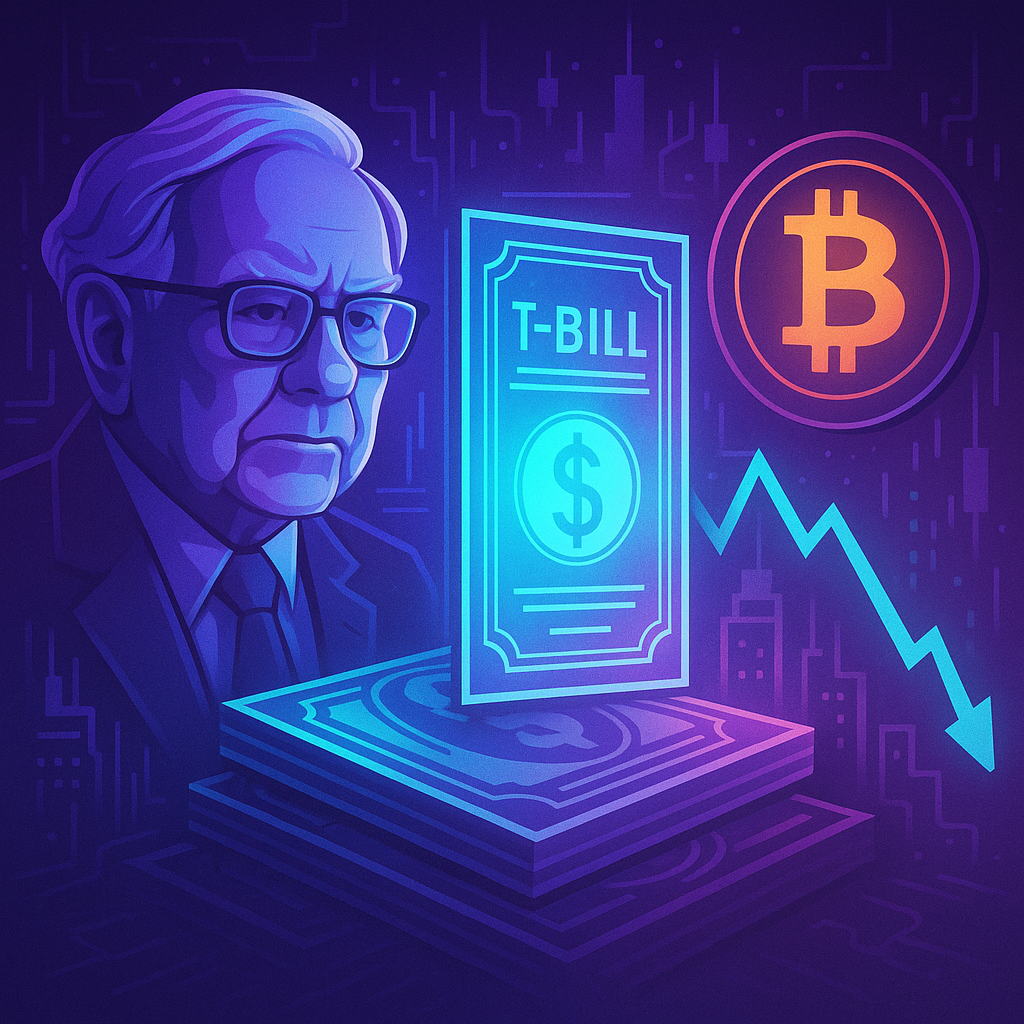
Warren Buffett, the renowned chairman of Berkshire Hathaway, made headlines recently after his firm invested approximately $17 billion in US Treasury bills during the latest auction. This significant move has sparked discussions regarding the potential implications for Bitcoin and the stock market in the near future.
Observers noted that Buffett’s accumulation of cash, totaling around $373 billion by the end of 2025, reflects a strategic shift that often precedes downturns in the stock market. This figure has more than doubled since 2023, raising questions about his outlook on risk assets like Bitcoin.

Buffett recently communicated that he does not consider the current decline in equity prices as a valuable entry point for investment. He characterized the recent pullback of around 5.75% in the S&P 500 as inconsequential compared to historic market collapses, in which declines exceeded 50%.
This perspective sheds light on Berkshire’s choice to invest in Treasury bills instead of stocks. Buffett’s historical behavior indicates a tendency to increase cash reserves prior to significant market corrections. Notably, during the late 1990s, as the Dot-com bubble was inflating, Buffett began to reduce his exposure to equities, ultimately ramping up cash reserves.
Since 2020, Bitcoin’s trading patterns have increasingly mirrored those of traditional stocks rather than behaving like a secure asset. This trend was highlighted by a recent 20-week correlation coefficient of 0.47 between Bitcoin and the Nasdaq, indicating a strong positive relationship between the two markets.
If Buffett’s caution proves to be well-founded, Bitcoin could face downward pressure alongside the stock market. Factors such as rising inflation linked to geopolitical tensions and concerns about an impending recession in the US further complicate the cryptocurrency’s outlook.

Berkshire Hathaway’s recent strategic decisions also indicate a distancing from cryptocurrency-related ventures. Earlier this year, the company divested from Nu Holdings, a fintech firm associated with crypto, securing substantial profits from this exit.
With analysts forecasting that Bitcoin’s price could dip to around $30,000 in 2026, the implications of Buffett’s large-scale Treasury bill purchase extend beyond mere investment strategy to potentially signal a challenging period ahead for cryptocurrencies.
In conclusion, Buffett’s $17 billion T-bill investment raises significant concerns about the future of Bitcoin and the wider market. As investors analyze these developments, the association between traditional equity markets and Bitcoin will continue to be scrutinized, particularly in light of recent economic indicators.
Leave the reaction
Elena Rodriguez










Commentaries
Add your comment
Fill in necessary fields and publish