


Bitcoin’s Future Uncertain Amid US-Iran Tensions
We have always followed the principles of transparency and clear information. Some of our content includes affiliate links, and we may earn a small commission through these partnerships. These partnerships do not influence our editorial independence or opinion. By using our site, you accept our privacy policy and terms and conditions.


Financial services expert with over three years of experience monitoring cryptocurrency markets and blockchain innovation. Passionate about digital assets and the decentralized future.
Cryptocurrency is a high-risk asset class, and investing carries significant risk, including the potential loss of some or all of your investment. The information on this website is provided for informational and educational purposes only and does not constitute financial, investment, or gambling advice. Cryptowinx does not endorse any specific exchange or gaming platform. For more details, please read our terms and full disclaimer.
Cryptowinx navigates the digital asset universe with a dynamic, forward-looking vision. Throughout our evolution, we have followed every market cycle, from vertical rises to corrections, always remaining a solid point of reference for our community. Our team is made up of industry experts and analysts who experience the blockchain ecosystem daily: we constantly monitor Bitcoin’s stability, study the expansion of the Ethereum ecosystem, and analyze the new frontiers of crypto casinos. We are committed to absolute editorial integrity, separating the signal from the noise through rigorous fact-checking and multi-perspective news analysis. In a landscape where innovations emerge in moments, our mission is to simplify complex concepts and offer transparency into what is established and what is still experimental.
Learn more Cryptowinx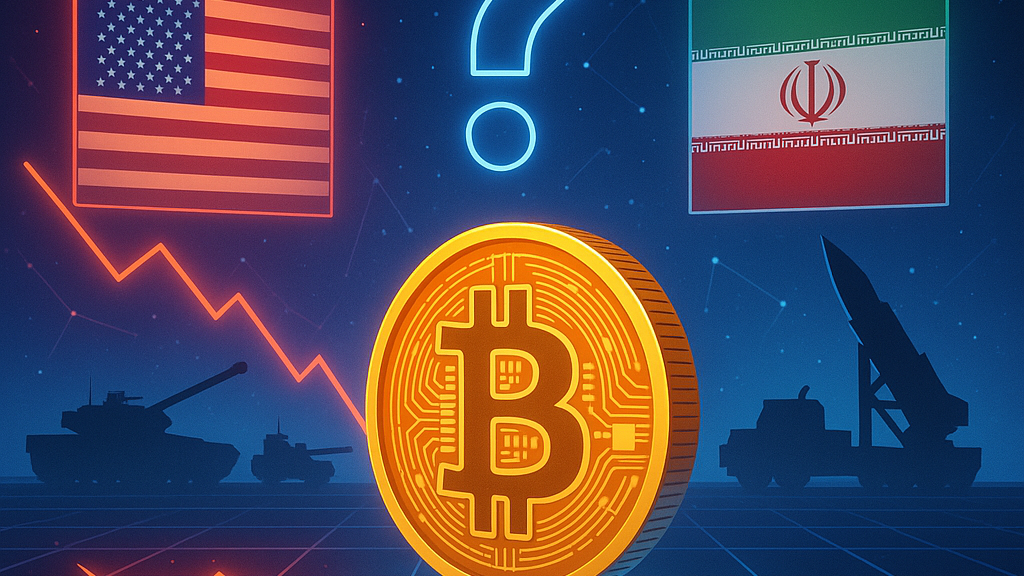
As of February 19, Bitcoin maintained a price around $66,400, demonstrating stability after experiencing recent fluctuations. However, escalating concerns regarding a possible US military intervention in Iran are casting a shadow over the cryptocurrency market.
Reports from several US media outlets indicate that military advisors have presented President Trump with options for potential strikes on Iran, suggesting that action could occur as soon as this weekend.

Amid these developments, sources have claimed that the likelihood of conflict with Iran is rising, with Israel reportedly preparing for military engagement that may unfold within days. This situation is posited to lead to a protracted conflict, distinctly different from earlier operations in Venezuela.
In response, the Pentagon has bolstered its military presence by dispatching additional aircraft and positioning a second carrier strike group in proximity to the Middle East. Iran, in turn, has been conducting military drills and has issued warnings of retaliation should they be attacked.
Geopolitical tensions have heightened due to stalled negotiations over Iran’s nuclear program and its advancements in uranium enrichment and missile capabilities. Although the White House continues to advocate for diplomatic solutions, officials have admitted that military responses are being contemplated, adding to the uncertainty in global markets.
This volatility in the global landscape is likewise reflected in Bitcoin’s price movements. Having previously soared above $100,000, it now hovers in the mid-$60,000 range, showing signs of distress.
The Short-Term Holder SOPR indicator has revealed that many short-term investors are exiting their positions at a loss, highlighting a trend of increasing vulnerability among recent market participants.
Moreover, Bitcoin’s short-term Sharpe ratio has plummeted to negative territory, indicating poor performance relative to its volatility—a condition typically associated with market unease.
In the event of a US military strike this weekend, Bitcoin’s response might unfold in two distinct phases.

The initial reaction could be a swift sell-off as investors tend to retreat to cash and safer assets during sudden geopolitical upheavals. Historically, Bitcoin has acted as a risk asset during early crisis phases, and the current SOPR data confirms that short-term holders are particularly sensitive to fear.
Conversely, the second phase could present a different scenario.
The negative Sharpe ratio suggests that Bitcoin is significantly oversold at this point, indicating that many weak hands have already left the market. This situation might lessen the potential for further forced selling, suggesting that any rapid downturn could be temporary if buyers begin to enter at lower price points.
Interestingly, periods of geopolitical instability can ultimately enhance Bitcoin’s attractiveness as an investment. Historically, when global tensions rise, many investors gravitate towards assets that operate outside conventional financial systems. While this transition does not occur instantaneously, it often develops gradually.
Currently, Bitcoin is positioned at a pivotal junction. With fear levels heightened and geopolitical risks on the rise, on-chain data implies that much of the adverse impact from the recent downturn may have already been absorbed. The market’s next move will largely hinge on whether tensions escalate into armed conflict or if diplomatic efforts prevail.
Leave the reaction
Gregory Russell









Commentaries
Add your comment
Fill in necessary fields and publish