


Czech Central Bank Embraces Bitcoin in Strategic Reserve Plan
We have always followed the principles of transparency and clear information. Some of our content includes affiliate links, and we may earn a small commission through these partnerships. These partnerships do not influence our editorial independence or opinion. By using our site, you accept our privacy policy and terms and conditions.


A crypto casino and gaming specialist, Raj brings a digital native’s perspective to industry trends and provably fair systems. Having reviewed over 150 platforms, he…
Cryptocurrency is a high-risk asset class, and investing carries significant risk, including the potential loss of some or all of your investment. The information on this website is provided for informational and educational purposes only and does not constitute financial, investment, or gambling advice. Cryptowinx does not endorse any specific exchange or gaming platform. For more details, please read our terms and full disclaimer.
Cryptowinx navigates the digital asset universe with a dynamic, forward-looking vision. Throughout our evolution, we have followed every market cycle, from vertical rises to corrections, always remaining a solid point of reference for our community. Our team is made up of industry experts and analysts who experience the blockchain ecosystem daily: we constantly monitor Bitcoin’s stability, study the expansion of the Ethereum ecosystem, and analyze the new frontiers of crypto casinos. We are committed to absolute editorial integrity, separating the signal from the noise through rigorous fact-checking and multi-perspective news analysis. In a landscape where innovations emerge in moments, our mission is to simplify complex concepts and offer transparency into what is established and what is still experimental.
Learn more Cryptowinx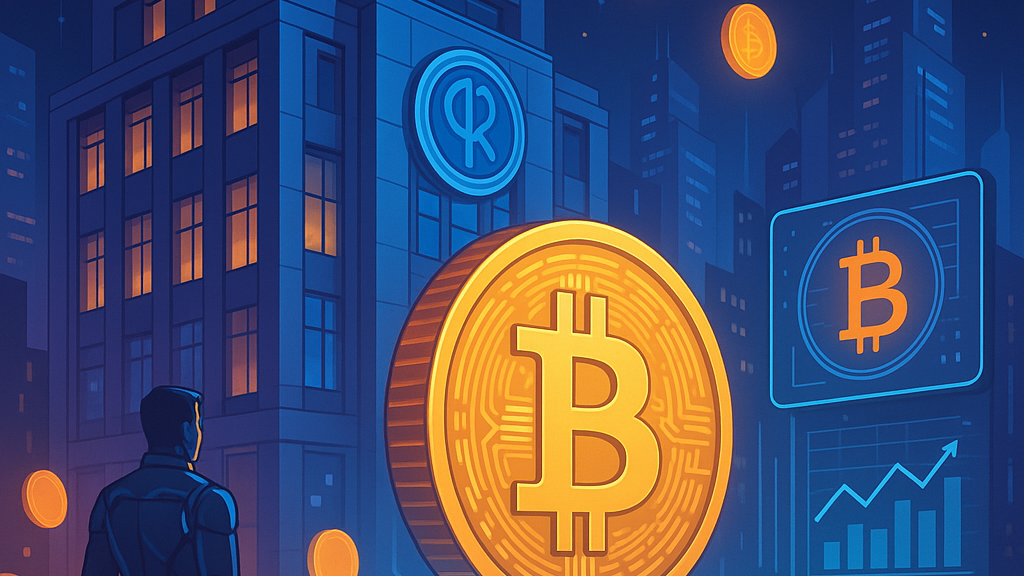
The governor of the Czech National Bank, Aleš Michl, recently took the opportunity at a Bitcoin industry event in Las Vegas to present the bank’s innovative yet cautious approach to reserve management. He emphasized the importance of integrating a modest Bitcoin allocation into the bank’s reserves, all while maintaining strict inflation control measures.
According to Michl, the decision to incorporate a small percentage of Bitcoin — specifically 1% — into the bank’s reserves aims to enhance expected returns without increasing the overall risk of the portfolio. He indicated that this strategy reflects a careful balance of adopting new financial instruments while sustaining the bank’s commitment to stability.

When he assumed his role in mid-2022, the Czech Republic was grappling with an inflation rate hovering around 20%. Michl noted the central bank’s commitment to reducing inflation back down to a targeted 2% within a two-year timeframe, underscoring that achieving this target required discipline rather than relying on quick fixes.
He critiqued the prolonged period of low-interest rates, which he argued had led to currency devaluation, citing a surplus of accessible credit in the market. As a response, the Czech National Bank has focused on encouraging savings and strengthening the Koruna, adopting a policy stance that Michl described as “hawkish indefinitely.”
During his address, he also highlighted the scale of the bank’s balance sheet, indicating that it oversees around $180 billion in foreign exchange reserves, an amount significant when compared to the Czech GDP. He characterized these reserves as some of the largest globally relative to the nation’s economic size.
Looking towards the future, Michl explained that the central bank is tasked with evolving its strategies to safeguard national interests, which necessitates a shift away from low-yielding bonds in favor of investments in higher-performing assets like stocks and gold through carefully managed portfolios.
As for Bitcoin, Michl acknowledged its notorious price volatility but pointed out that it is not alone in this regard; other assets experience similar fluctuations. He asserted that the more critical consideration for a central bank lies in how each asset operates within a comprehensive portfolio strategy.

The findings from research conducted by the bank suggested that Bitcoin demonstrates a low long-term correlation with many traditional reserve assets. Michl argued that including Bitcoin could lead to better returns that do not necessarily follow the same patterns as existing holdings, which ultimately justifies the decision to allocate 1% of reserves to Bitcoin.
This thoughtful integration, he stated, results in improved returns in terms of the Czech Koruna while maintaining a stable overall risk profile. For Michl, the essence of this decision is linked to diversification, which he presented as a beneficial approach for the bank’s financial strategy.
In summation, Michl conveyed a vision of central banking that champions a “conservative yet innovative” mindset amid the rise of digital assets. The Czech National Bank’s dedication to a robust anti-inflationary strategy goes hand in hand with its cautious exploration of Bitcoin and other unconventional assets to enhance its financial resilience over time.
Leave the reaction
Raj Patel









Commentaries
Add your comment
Fill in necessary fields and publish