


Litecoin’s MWEB Bug Exploit: How Attackers Manipulated the Chain
We have always followed the principles of transparency and clear information. Some of our content includes affiliate links, and we may earn a small commission through these partnerships. These partnerships do not influence our editorial independence or opinion. By using our site, you accept our privacy policy and terms and conditions.


Financial services expert with over three years of experience monitoring cryptocurrency markets and blockchain innovation. Passionate about digital assets and the decentralized future.
Cryptocurrency is a high-risk asset class, and investing carries significant risk, including the potential loss of some or all of your investment. The information on this website is provided for informational and educational purposes only and does not constitute financial, investment, or gambling advice. Cryptowinx does not endorse any specific exchange or gaming platform. For more details, please read our terms and full disclaimer.
Cryptowinx navigates the digital asset universe with a dynamic, forward-looking vision. Throughout our evolution, we have followed every market cycle, from vertical rises to corrections, always remaining a solid point of reference for our community. Our team is made up of industry experts and analysts who experience the blockchain ecosystem daily: we constantly monitor Bitcoin’s stability, study the expansion of the Ethereum ecosystem, and analyze the new frontiers of crypto casinos. We are committed to absolute editorial integrity, separating the signal from the noise through rigorous fact-checking and multi-perspective news analysis. In a landscape where innovations emerge in moments, our mission is to simplify complex concepts and offer transparency into what is established and what is still experimental.
Learn more Cryptowinx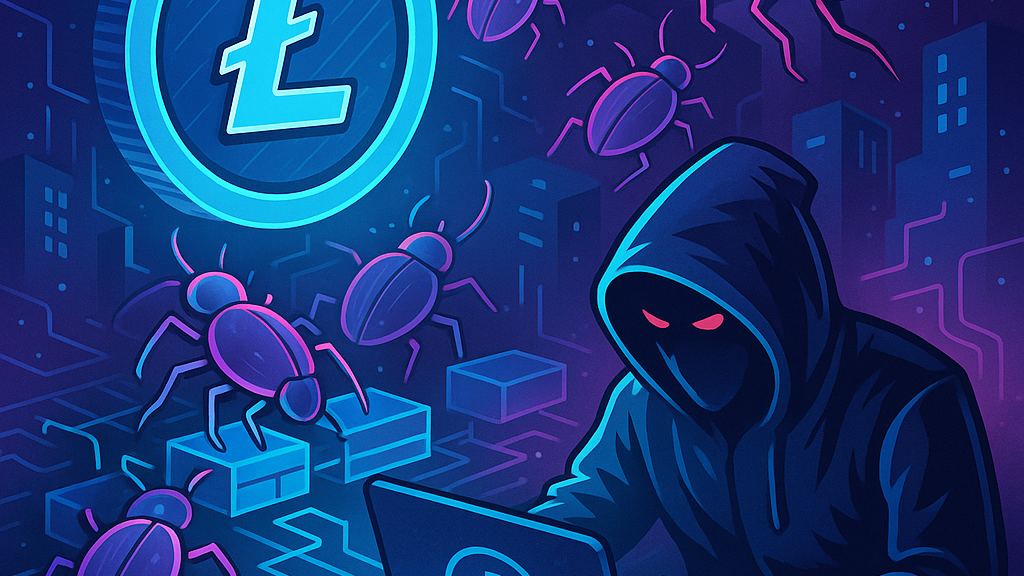
In a recent disclosure, Litecoin developers detailed security vulnerabilities linked to a significant bug in the Mimblewimble Extension Block (MWEB) validation. This bug allowed an attacker to falsely create a pegout of 85,034 LTC, revealing serious flaws within the network’s security framework.
According to the developers, the issue arose from a failure to verify important metadata during the connection of blocks. This was particularly critical when an MWEB input attempted to use a previous output, as the metadata must align with the actual unspent transaction outputs (UTXOs). While checks were conducted in the mempool and block-building stages, they were not enforced adequately during the block connection process.

The vulnerability came to light on March 19 during an internal review, where a scan of the blockchain indicated that the exploit had already happened. Specifically, at block 3,073,882, the attacker managed to utilize a malicious MWEB input valued at just over 1.2 LTC to initiate a pegout of more than 85,000 LTC.
To address the situation, developers quickly coordinated with major mining operations to mitigate the impact of the inflated outputs before any public announcement. This effort led to a rapid emergency release of Litecoin Core 0.21.5, designed to block new malformed inputs. A subsequent update, version 0.21.5.1, included a historical exception for the compromised block and temporarily froze the three transparent outputs containing the funds obtained by the attacker.
When the attacker attempted to access one of the frozen outputs, upgraded miners blocked the transaction. Following this, direct communication was established with the attacker, who opted to return the majority of the funds. The recovery process involved returning 84,184 LTC to an address controlled by the developers, while the attacker retained a bounty of 850 LTC for their cooperation.
Litecoin’s founder, Charlie Lee, contributed by purchasing the necessary 850 LTC to restore the MWEB balance, allowing the funds to be pegged back in a single transaction. Fortunately, no user funds were lost in this incident.
However, the challenges did not end there. In April, another exploit attempt triggered a 13-block chain reorganization, impacting NEAR Intents and Thorchain. Although upgraded nodes successfully rejected the malformed block, issues arose with how mutated MWEB block data was managed, causing certain commands to freeze while non-upgraded miners continued to expand the invalid chain.

The aftermath saw NEAR Intents suffering a loss of 11,000 LTC exchanged for 7.78 BTC before the reorganization was completed, while Thorchain reported a separate incident involving a loss through its bridge.
In light of these events, developers have released Litecoin Core 0.21.5.4 to eliminate the problems associated with mutated block stalls, effectively allowing valid data to be accepted again. This version was disseminated publicly on April 25.
The postmortem acknowledged several shortcomings in the initial response, including the over-reliance on checks not applied at the block connection stage. It emphasized the risks associated with staged releases and the lack of testing for the April exploit’s failure mode against mining RPC behavior.
Despite the challenges faced, community feedback has been largely positive, with a significant portion expressing gratitude for the team’s transparency and quick action. Many noted that the integrity of the blockchain remained intact, reinforcing trust within the community following the disclosure.
Leave the reaction
Gregory Russell












Commentaries
Add your comment
Fill in necessary fields and publish