


US Admiral Highlights Bitcoin’s Role in Cybersecurity Strategy
We have always followed the principles of transparency and clear information. Some of our content includes affiliate links, and we may earn a small commission through these partnerships. These partnerships do not influence our editorial independence or opinion. By using our site, you accept our privacy policy and terms and conditions.


A Senior Altcoin Analyst, Sarah combines on-chain data with a background in venture capital research. With a Master’s in Computer Science, she provides precise evaluations…
Cryptocurrency is a high-risk asset class, and investing carries significant risk, including the potential loss of some or all of your investment. The information on this website is provided for informational and educational purposes only and does not constitute financial, investment, or gambling advice. Cryptowinx does not endorse any specific exchange or gaming platform. For more details, please read our terms and full disclaimer.
Cryptowinx navigates the digital asset universe with a dynamic, forward-looking vision. Throughout our evolution, we have followed every market cycle, from vertical rises to corrections, always remaining a solid point of reference for our community. Our team is made up of industry experts and analysts who experience the blockchain ecosystem daily: we constantly monitor Bitcoin’s stability, study the expansion of the Ethereum ecosystem, and analyze the new frontiers of crypto casinos. We are committed to absolute editorial integrity, separating the signal from the noise through rigorous fact-checking and multi-perspective news analysis. In a landscape where innovations emerge in moments, our mission is to simplify complex concepts and offer transparency into what is established and what is still experimental.
Learn more Cryptowinx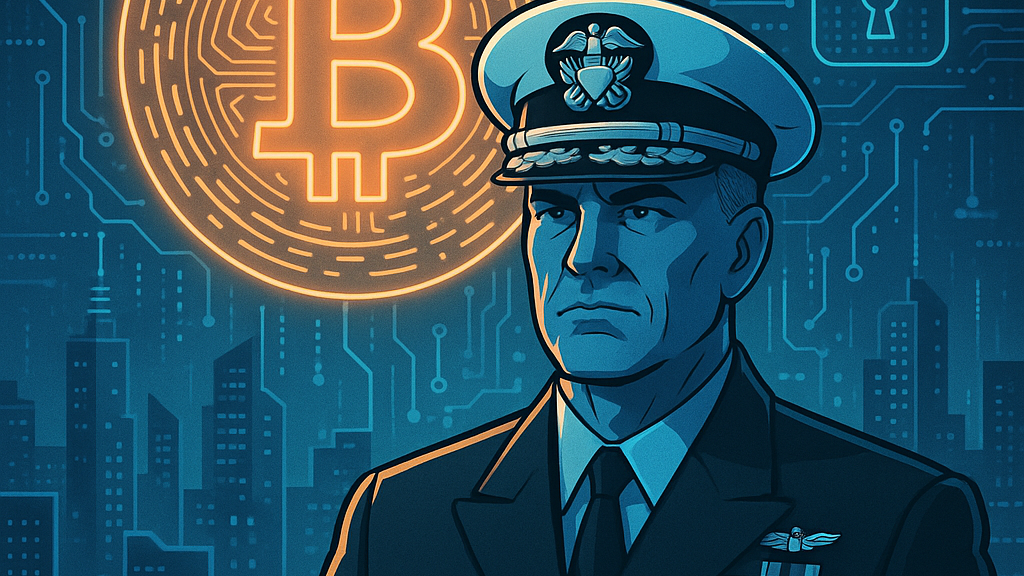
In a recent Senate Armed Services Committee hearing, Admiral Samuel Paparo of the US Navy emphasized the significant capabilities of Bitcoin beyond its financial implications, positioning it as an influential asset for national security.
During his remarks, Paparo described Bitcoin’s proof-of-work technology as a crucial advancement in computer science, particularly with regards to cybersecurity. He suggested that the technology has practical applications that could bolster the nation’s defenses against cyber threats.

He elaborated that Bitcoin’s network creates substantial hurdles for potential attackers, as the technology requires considerable resources to compromise. Paparo stated that while many perceive Bitcoin primarily as a cryptocurrency, its broader implications for data security must not be overlooked.
His comments were part of a broader discussion regarding the US military posture in the Indo-Pacific region, particularly in light of ongoing geopolitical tensions involving Russia, China, and North Korea. The Admiral acknowledged Bitcoin’s potential as a protective measure against the rising tide of cyberattacks from state-sponsored actors who utilize tactics like phishing and ransomware.
Reference was made to previous statements by Jason Lowery from the US Space Force, who underscored Bitcoin’s ability to secure not just financial transactions but also various forms of communication and command data. Paparo has echoed this sentiment, explaining that the strategic value of Bitcoin for cybersecurity and national security is often underestimated.
Addressing a question from Senator Tommy Tuberville regarding the US’s competitive stance in the global Bitcoin landscape, Paparo noted that Bitcoin’s relevance as a peer-to-peer transfer system cannot be dismissed. He affirmed that any tool that empowers the US nationally is beneficial.

The discussion comes at a time when US Senators Bill Cassidy and Cynthia Lummis have introduced legislation aimed at enhancing national security through domestic Bitcoin mining. Their proposed Mined in America Act seeks to address foreign dependency in Bitcoin mining equipment manufacturing and aims to establish the Strategic Bitcoin Reserve.
As the implications of cryptocurrency evolve, military leaders continue to recognize the importance of harnessing emerging technologies to safeguard national interests. Admiral Paparo’s advocacy for Bitcoin highlights the growing perception of digital currencies as strategic components in the defense landscape.
Leave the reaction
Sarah Chen










Commentaries
Add your comment
Fill in necessary fields and publish