


Crypto Market Faces Sharp Decline as Trading Volume Plummets
We have always followed the principles of transparency and clear information. Some of our content includes affiliate links, and we may earn a small commission through these partnerships. These partnerships do not influence our editorial independence or opinion. By using our site, you accept our privacy policy and terms and conditions.


A presale and tokenomics specialist, Sofia evaluates new crypto projects with the analytical rigor of her Bocconi background. Having reviewed over 200 launches, she excels…
Cryptocurrency is a high-risk asset class, and investing carries significant risk, including the potential loss of some or all of your investment. The information on this website is provided for informational and educational purposes only and does not constitute financial, investment, or gambling advice. Cryptowinx does not endorse any specific exchange or gaming platform. For more details, please read our terms and full disclaimer.
Cryptowinx navigates the digital asset universe with a dynamic, forward-looking vision. Throughout our evolution, we have followed every market cycle, from vertical rises to corrections, always remaining a solid point of reference for our community. Our team is made up of industry experts and analysts who experience the blockchain ecosystem daily: we constantly monitor Bitcoin’s stability, study the expansion of the Ethereum ecosystem, and analyze the new frontiers of crypto casinos. We are committed to absolute editorial integrity, separating the signal from the noise through rigorous fact-checking and multi-perspective news analysis. In a landscape where innovations emerge in moments, our mission is to simplify complex concepts and offer transparency into what is established and what is still experimental.
Learn more Cryptowinx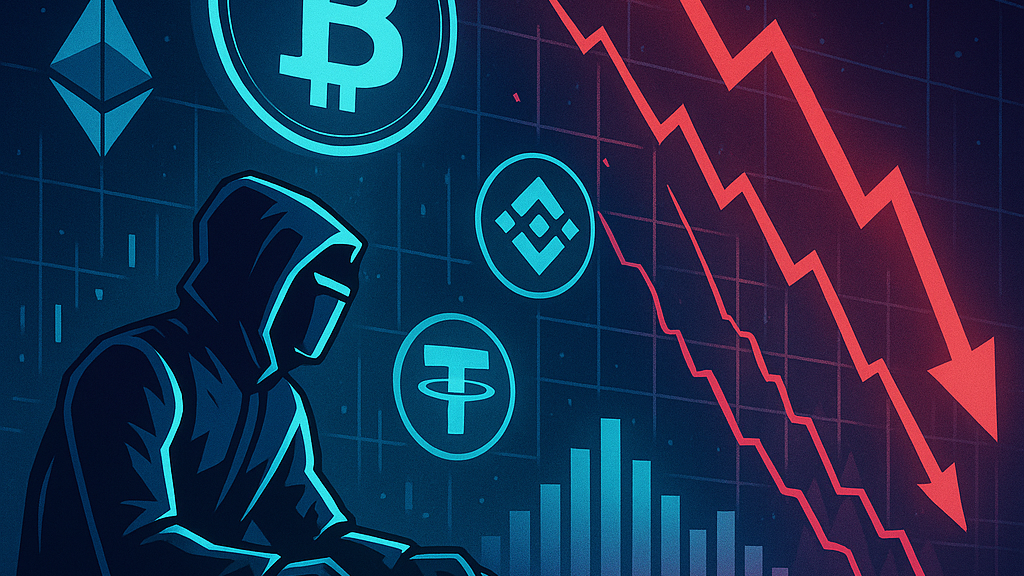
Recent analysis indicates that the digital asset market may be experiencing a significant downturn, often referred to as a “crypto winter.” This evolution is marked by a sustained decrease in trading volumes and market capitalization over two consecutive quarters.
CoinGecko’s latest report signifies a transition in the market’s landscape, noting the shift from a brief correction phase to a prolonged crypto winter as we entered Q1 of 2026. This change was suggested to be influenced by a combination of previous bearish trends and escalating global geopolitical uncertainties.

The Q1 report for 2026 indicates a notable contraction, with the total cryptocurrency market capitalization dropping approximately 20.4%, equating to around $622 billion. By the end of the first quarter, the market capitalization stood at $2.4 trillion, demonstrating a second quarter of decline.
This downward spiral intensified between mid-January and early February, resulting in the market valuation falling to about 45% below its peak of $4.27 trillion recorded in October. Daily trading activities also saw a significant decline of 27.2% Quarter-over-Quarter (QoQ), averaging a daily trading volume of $117.8 billion.
Centralized exchanges (CEXes), including major players like Binance and MEXC, reported a staggering 39.1% QoQ drop in their spot trading volume, settling at $2.7 trillion by the end of Q1. Although trading volume was above the $1 trillion mark in January, it dwindled through the subsequent months, with March registering just $0.8 trillion—a stark low not seen since November 2023.
Despite Binance’s continued dominance with a 37% market share, it was joined by MEXC which managed to hold on to a double-digit share at 10%. The report highlighted that every major exchange within the top 10 saw declines in trading volume, some suffering losses between 23% and 55%. HTX experienced the most significant drop, seeing its quarterly trading volume reduce from $294.4 billion in 2025 Q4 to just $133.6 billion in 2026 Q1, resulting in a market share decline to 4.9%.

Major cryptocurrencies also faced setbacks, with Bitcoin (BTC) declining by 22% in this quarter. Though it performed slightly better than various other leading assets, it remained below the performance of traditional investments such as oil, gold, and the S&P 500. Ethereum (ETH), BNB, XRP, and Solana (SOL) exhibited similar downturns, placing pressure on the overall market capitalization.
While some altcoins like Hyperliquid (HYPE) and Bittensor (TAO) managed to stand out with relative strength after the Q4 2025 sell-off, others continued to struggle. Stablecoins, on the other hand, displayed remarkable stability during this tumultuous period. The overall stablecoin market capitalization showed nearly no change, with a slight 0.5% increase to finish the quarter at $309.9 billion. Tether (USDT) saw its supply decrease by 1.6%, marking its first notable drop since Q2 2022. Conversely, Circle’s USDC saw growth, reaching $77.1 billion.
In summary, despite the difficulties besieging the broader crypto market in Q1, stablecoins have reaffirmed their importance as a reliable liquidity source, underscoring their critical role during this time of volatility.
Leave the reaction
Sofia Russo












Commentaries
Add your comment
Fill in necessary fields and publish