


Ravencoin RVN Price Outlook for 2026, 2027, and 2030
We have always followed the principles of transparency and clear information. Some of our content includes affiliate links, and we may earn a small commission through these partnerships. These partnerships do not influence our editorial independence or opinion. By using our site, you accept our privacy policy and terms and conditions.


James Mitchell combines investment banking with cryptocurrency journalism to analyze the institutional adoption of digital assets. Specializing in ETFs and regulation, he translates complex developments…
Cryptocurrency is a high-risk asset class, and investing carries significant risk, including the potential loss of some or all of your investment. The information on this website is provided for informational and educational purposes only and does not constitute financial, investment, or gambling advice. Cryptowinx does not endorse any specific exchange or gaming platform. For more details, please read our terms and full disclaimer.
Cryptowinx navigates the digital asset universe with a dynamic, forward-looking vision. Throughout our evolution, we have followed every market cycle, from vertical rises to corrections, always remaining a solid point of reference for our community. Our team is made up of industry experts and analysts who experience the blockchain ecosystem daily: we constantly monitor Bitcoin’s stability, study the expansion of the Ethereum ecosystem, and analyze the new frontiers of crypto casinos. We are committed to absolute editorial integrity, separating the signal from the noise through rigorous fact-checking and multi-perspective news analysis. In a landscape where innovations emerge in moments, our mission is to simplify complex concepts and offer transparency into what is established and what is still experimental.
Learn more Cryptowinx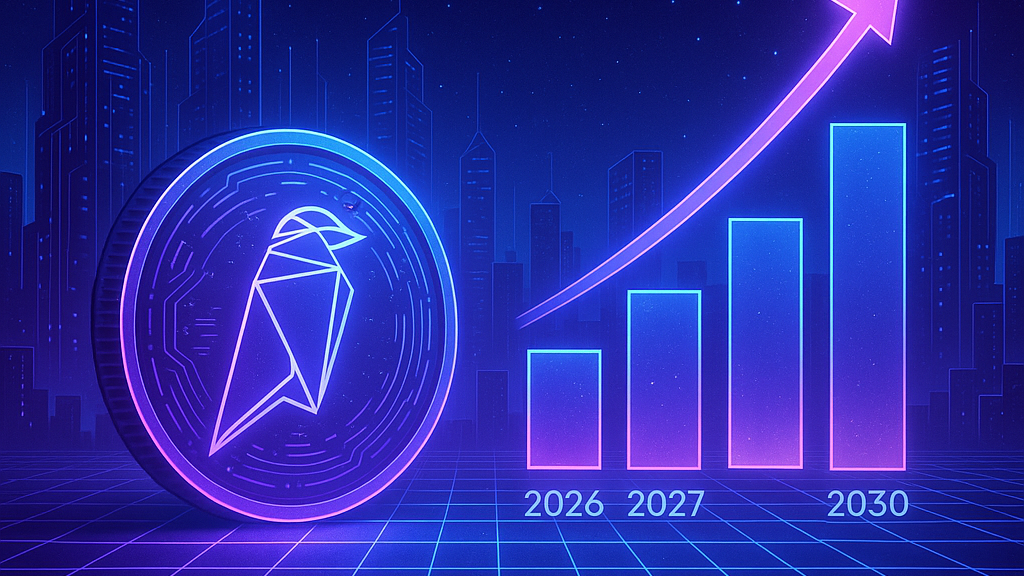
The quest for whether Ravencoin (RVN) can achieve a price of $1 has sparked considerable debate in the crypto community. With its current value hovering around $0.0056, such a leap represents a staggering 180-fold increase.
This ambitious target would propel Ravencoin’s market capitalization to approximately $16 billion, positioning it alongside notable cryptocurrencies like Avalanche and Chainlink. While reaching $1 is not outside the realm of possibility, it would require a significant shift in how the market perceives Ravencoin, moving it towards recognition as a leading blockchain platform.

Ravencoin’s inception in January 2018 positioned it as the first blockchain dedicated to asset tokenization, predating the recent rise of Real World Assets (RWA) discussions that have gained traction since 2024. However, despite being a pioneer, the platform has struggled for visibility, overshadowed by more prominent networks such as Ethereum and Solana, which have become the go-to solutions for developers.
As April 2026 approaches, the effects of Ravencoin’s second halving on January 15, which reduced block rewards from 2,500 to 1,250 RVN, are notable. This halving decreased the daily issuance of new RVN from approximately 3.6 million to 1.8 million, impacting supply dynamics significantly. The official Ravencoin account hinted at the uncertainty surrounding the project, reinforcing the challenges it faces.
Ravencoin’s unique features, including a one-minute block time and a maximum supply of 21 billion coins, differentiate it from Bitcoin. The mining algorithm, KaWPoW, promotes decentralization by making it accessible to GPU miners, ensuring that the project’s grassroots foundation remains intact.
Another crucial aspect is the asset creation mechanism that requires burning RVN, linking the number of tokens created directly to the coin’s scarcity—a factor that could work in RVN’s favor as the network sees more activity.
With the RWA sector expanding exponentially, the demand for dedicated tokenization solutions is rising. However, Ravencoin has not yet capitalized on this narrative in a competitive environment dominated by well-funded entities. Its community-driven governance model lacks the support that institutional players often seek, which may hinder broader adoption.

The upcoming Gravity Upgrade, anticipated in late 2025, aims to streamline transaction processes and enhance the platform’s usability. Such enhancements could make Ravencoin more attractive for developers seeking a reliable ecosystem for asset transfers.
By 2027, the aftermath of the Gravity Upgrade will influence Ravencoin’s trajectory. The market’s appetite for asset tokenization versus the performance of broader crypto trends will be critical for RVN’s growth. Whether the interest in RWA extends to Ravencoin will depend on effective community-driven promotion.
Looking ahead to 2030, the third halving is expected to further tighten the supply of RVN, reducing block rewards to 625 per block. The anticipated growth in the RWA sector could favor Ravencoin if it capitalizes on its foundational strengths. However, the risk of being eclipsed by Ethereum and other EVM-compatible chains remains a concern.
In conclusion, while the question of RVN reaching $1 is driven by speculative enthusiasm, the more pressing narrative centers around Ravencoin’s capacity to sustain its community-driven development and adaptability within an increasingly competitive market. The future lies in whether this original asset tokenization platform can resonate with emerging trends and gain the attention it deserves.
Leave the reaction
James Mitchell





Commentaries
Add your comment
Fill in necessary fields and publish