


Artifacts of Dissent: Art, Money, and a Call for Change
We have always followed the principles of transparency and clear information. Some of our content includes affiliate links, and we may earn a small commission through these partnerships. These partnerships do not influence our editorial independence or opinion. By using our site, you accept our privacy policy and terms and conditions.


Financial services expert with over three years of experience monitoring cryptocurrency markets and blockchain innovation. Passionate about digital assets and the decentralized future.
Cryptocurrency is a high-risk asset class, and investing carries significant risk, including the potential loss of some or all of your investment. The information on this website is provided for informational and educational purposes only and does not constitute financial, investment, or gambling advice. Cryptowinx does not endorse any specific exchange or gaming platform. For more details, please read our terms and full disclaimer.
Cryptowinx navigates the digital asset universe with a dynamic, forward-looking vision. Throughout our evolution, we have followed every market cycle, from vertical rises to corrections, always remaining a solid point of reference for our community. Our team is made up of industry experts and analysts who experience the blockchain ecosystem daily: we constantly monitor Bitcoin’s stability, study the expansion of the Ethereum ecosystem, and analyze the new frontiers of crypto casinos. We are committed to absolute editorial integrity, separating the signal from the noise through rigorous fact-checking and multi-perspective news analysis. In a landscape where innovations emerge in moments, our mission is to simplify complex concepts and offer transparency into what is established and what is still experimental.
Learn more Cryptowinx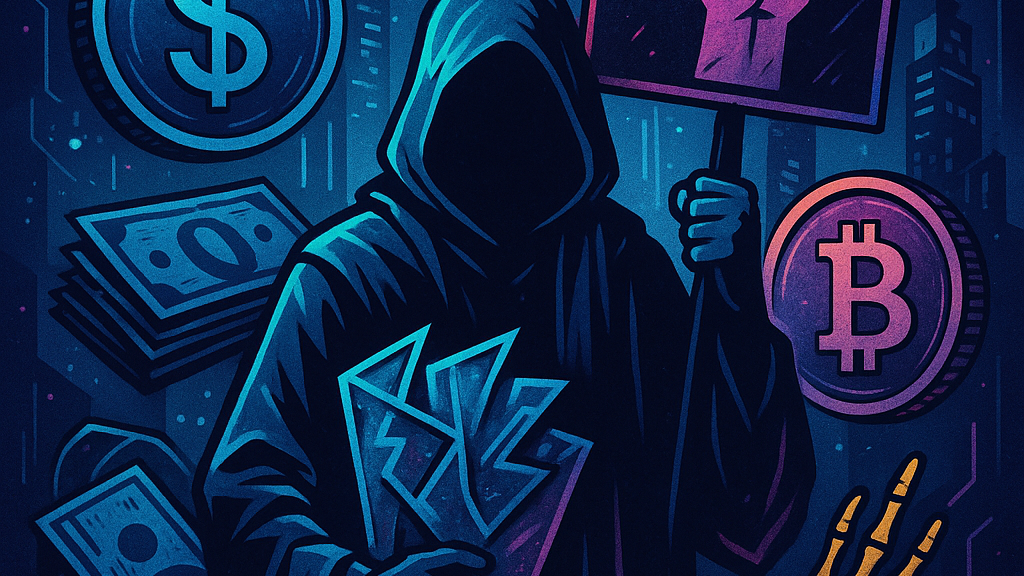
Revolutions often leave their mark through various artifacts. These do not always take the form of weapons or flags; instead, they can manifest as subtle symbols of resistance that speak volumes about societal discontent. From a poster displayed on an overpass in Los Angeles to a sign held aloft outside a Tokyo office, these humble gestures can carry profound significance, often echoing themes of dissent and aspirations for freedom.
The exhibition titled Relics of a Revolution was showcased at the Bitcoin 2026 Conference in Las Vegas, highlighting the interconnectedness between grassroots activism and the emergence of Bitcoin. One notable artist, Mear One, has long utilized the urban landscape of Los Angeles as his canvas for political statements, having begun his journey in the late 1980s. Mear One was a pioneer of the Melrose graffiti movement and participated in groundbreaking art shows. His works, which were prominently featured in the Art in the Streets exhibition at the Los Angeles Museum of Contemporary Art, span decades of critique on political and economic oppression.

In a conversation prior to his panel at Bitcoin 2026, Mear One reflected on the role of art in activism. He described graffiti as an outlet for the disenchanted, a means to convey messages to the public before the digital age fully established itself. He emphasized that public art can resonate deeply with urban dwellers, offering a form of rebellion against existing power structures and engaging the community in a dialogue about systemic issues.
Throughout his career, Mear One has drawn parallels between his artistic pursuits and the evolution of Bitcoin. He remarked that discovering Bitcoin reminded him of the underground culture of graffiti and punk rock, which sought to challenge the status quo. He believes that both art and Bitcoin embody a quest for freedom from systems that perpetuate inequality and conflict.
The interview provided insight into Mear One’s artistic philosophy, illustrating how his experiences on the anti-war art circuit in the early 2000s shaped his understanding of economic systems. He characterized his art as a visceral response to what he perceives as a pervasive sense of entrapment within contemporary economic structures, culminating in works that expose the underlying motivations behind global conflicts.
Interestingly, street art like Mear One’s carries a transitory nature, often subject to destruction or removal. Yet, some of his works from earlier protests remain significant today, serving as historical artifacts of an ongoing struggle against societal injustices. He emphasized that these pieces remain relevant because the root issues they address persist.
Discussing the cyclical nature of revolution, Mear One expressed his belief that the fight for change is a continuous process. Each generation faces its own challenges, and art plays a vital role in fostering awareness and promoting discourse around these issues.
As he looks to the future, Mear One is hopeful about the potential for movements like Bitcoin to inspire change. He sees them as tools for breaking free from the constraints of the existing financial system and facilitating a broader dialogue on freedom and human connection.
In conclusion, the exhibition Relics of a Revolution, featuring Mear One alongside significant historical artifacts, serves as a reminder of the ongoing quest for freedom from oppressive systems. It invites viewers to consider not just the artistic expressions of rebellion, but also the underlying narratives that continue to shape our world today.
Leave the reaction
Gregory Russell












Commentaries
Add your comment
Fill in necessary fields and publish