


Ripple’s Journey Since 2018: Progress and Ongoing Challenges
We have always followed the principles of transparency and clear information. Some of our content includes affiliate links, and we may earn a small commission through these partnerships. These partnerships do not influence our editorial independence or opinion. By using our site, you accept our privacy policy and terms and conditions.


A Senior Altcoin Analyst, Sarah combines on-chain data with a background in venture capital research. With a Master’s in Computer Science, she provides precise evaluations…
Cryptocurrency is a high-risk asset class, and investing carries significant risk, including the potential loss of some or all of your investment. The information on this website is provided for informational and educational purposes only and does not constitute financial, investment, or gambling advice. Cryptowinx does not endorse any specific exchange or gaming platform. For more details, please read our terms and full disclaimer.
Cryptowinx navigates the digital asset universe with a dynamic, forward-looking vision. Throughout our evolution, we have followed every market cycle, from vertical rises to corrections, always remaining a solid point of reference for our community. Our team is made up of industry experts and analysts who experience the blockchain ecosystem daily: we constantly monitor Bitcoin’s stability, study the expansion of the Ethereum ecosystem, and analyze the new frontiers of crypto casinos. We are committed to absolute editorial integrity, separating the signal from the noise through rigorous fact-checking and multi-perspective news analysis. In a landscape where innovations emerge in moments, our mission is to simplify complex concepts and offer transparency into what is established and what is still experimental.
Learn more Cryptowinx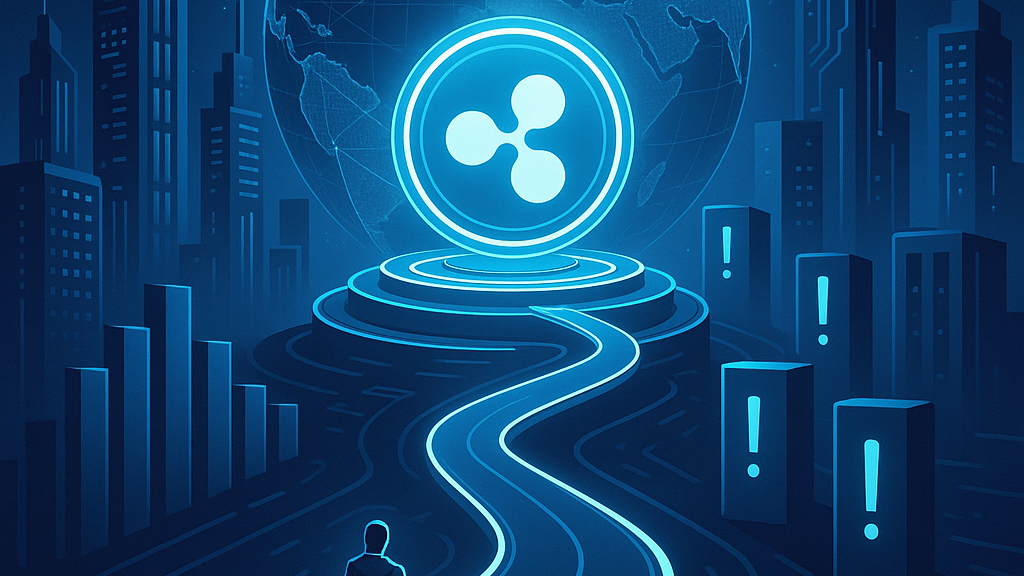
A clip from 2018 featuring Ripple’s CEO, Brad Garlinghouse, has recently gained attention again, showcasing his ambitious prediction that the company would surpass SWIFT in global financial communications. At that point, Ripple was an emerging player in the cryptocurrency space, promoting its technology as a more efficient alternative to traditional banking systems like SWIFT.
During the 2018 interview with Bloomberg, Garlinghouse expressed his conviction about Ripple’s trajectory, indicating that their daily activities were fundamentally changing the landscape of global payments. He highlighted that over 100 financial institutions had partnered with Ripple, many of which were already utilizing its innovative technology instead of SWIFT.

His remarks illustrated the confidence Ripple had in its solution, especially when he detailed a case where a remittance service drastically reduced transaction costs from $20 to $2 after implementing Ripple’s system. This led to an impressive 800% increase in transaction volume overnight, a metric Garlinghouse believed underscored Ripple’s potential to outperform traditional banking methods.
Despite such optimism, skepticism remains prevalent within the cryptocurrency sector. Many within the community question whether Ripple can genuinely rival SWIFT, which has been the cornerstone of international financial transactions since 1973. SWIFT’s reputation is built on decades of reliability and established security protocols, areas where Ripple is still navigating its path.
However, SWIFT is facing challenges where Ripple seeks to excel. Transactions through SWIFT can take several days to settle, while Ripple facilitates transfers in mere seconds. The costs also differ dramatically; while SWIFT fees can range between $25 and $50 per transaction, Ripple offers a significantly lower fee structure, often costing between $0.001 and $0.01.
Moreover, one of SWIFT’s limitations is its reliance on pre-funded Nostro accounts for transactions. Conversely, Ripple’s solution uses On-Demand Liquidity (ODL), employing XRP as a bridge currency. This allows for the rapid conversion of currencies, completing transactions efficiently without the delays typically associated with traditional banking.

As time has progressed, Ripple has experienced substantial growth and faced various challenges since that pivotal year of 2018. The company emerged from a prolonged legal dispute with the U.S. SEC, gaining clearer regulatory guidance which has enhanced its standing in the industry. Furthermore, Ripple has been active in expanding its global presence while updating the XRP Ledger to bolster its security features.
Today, Ripple’s strategy involves either competing with or collaborating alongside SWIFT. It has forged partnerships with numerous banks and financial institutions, broadening its offerings and venturing into areas such as custodial services and treasury management. Recent achievements, including gaining conditional approval for a banking charter from the Office of the Comptroller of the Currency (OCC), mark significant milestones in Ripple’s evolution.
As Ripple continues to navigate the landscape of digital finance, the company’s journey from 2018 highlights not only its ambitions but also the ongoing challenges it must address to solidify its position in the competitive space of global payments.
Leave the reaction
Sarah Chen










Commentaries
Add your comment
Fill in necessary fields and publish