


Market Shifts as US-Iran Deal Approaches Amid Tensions
We have always followed the principles of transparency and clear information. Some of our content includes affiliate links, and we may earn a small commission through these partnerships. These partnerships do not influence our editorial independence or opinion. By using our site, you accept our privacy policy and terms and conditions.


A Senior Altcoin Analyst, Sarah combines on-chain data with a background in venture capital research. With a Master’s in Computer Science, she provides precise evaluations…
Cryptocurrency is a high-risk asset class, and investing carries significant risk, including the potential loss of some or all of your investment. The information on this website is provided for informational and educational purposes only and does not constitute financial, investment, or gambling advice. Cryptowinx does not endorse any specific exchange or gaming platform. For more details, please read our terms and full disclaimer.
Cryptowinx navigates the digital asset universe with a dynamic, forward-looking vision. Throughout our evolution, we have followed every market cycle, from vertical rises to corrections, always remaining a solid point of reference for our community. Our team is made up of industry experts and analysts who experience the blockchain ecosystem daily: we constantly monitor Bitcoin’s stability, study the expansion of the Ethereum ecosystem, and analyze the new frontiers of crypto casinos. We are committed to absolute editorial integrity, separating the signal from the noise through rigorous fact-checking and multi-perspective news analysis. In a landscape where innovations emerge in moments, our mission is to simplify complex concepts and offer transparency into what is established and what is still experimental.
Learn more Cryptowinx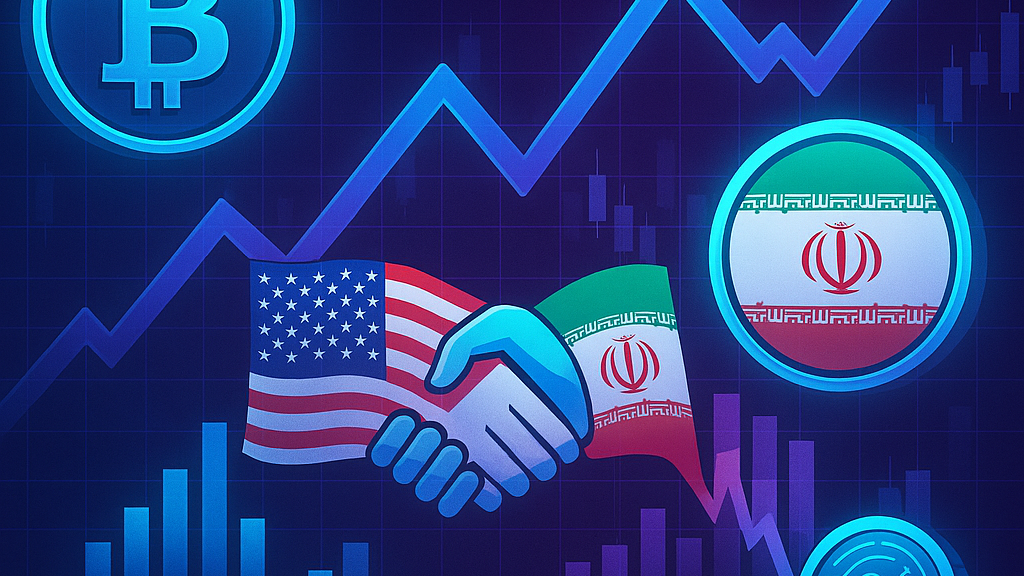
On April 7, oil prices saw a significant decline while Bitcoin made a notable recovery, nearing the $70,000 threshold. This shift in the financial landscape was largely due to market reactions to emerging news of a potential diplomatic breakthrough between the United States and Iran.
According to reports, a deal between the US and Iran was anticipated to be finalized that evening, raising hopes for an easing of tensions. Speculation surrounding this development helped Bitcoin rebound, inching back up to approximately $69,900 after earlier declines. Conversely, oil prices faced downward pressure as traders assessed the diminishing likelihood of supply disruptions.

Earlier that day, President Trump had set a strict deadline for the negotiations, insisting that by 8 p.m. ET (midnight GMT), Iran must respond to a US proposal which included the reopening of the strategically vital Strait of Hormuz. He warned that failure to reach an agreement could result in severe military action, targeting key infrastructures, including power facilities and transport networks.
The intensity of the situation escalated quickly, with Trump making alarming statements about the potential catastrophic consequences of non-compliance, suggesting that vast losses of life could ensue. Amid this backdrop of heightened tension, Israeli and US military activities increased against Iranian objectives in anticipation of the deadline.
In response, Iranian officials threatened retaliatory measures, calling for civilians to protect crucial infrastructures by forming human chains around them.
Market activity reflected the real-time developments of the situation. As concerns about disruptions to global supply chains mounted, oil prices initially surged, while other risk-sensitive assets, including cryptocurrencies, exhibited significant volatility. However, as the narrative shifted towards the prospect of positive diplomatic moves, oil’s price corrected downward significantly.

In the final hours leading to the deadline, diplomatic negotiations picked up momentum, with Pakistan stepping in as a mediator. Pakistani Prime Minister Shehbaz Sharif formally requested an extension of two weeks to facilitate ongoing discussions, advocating for both sides to agree to a temporary ceasefire and reopen the Strait of Hormuz as a gesture of goodwill.
The White House confirmed that President Trump was evaluating this proposal, and US officials noted that talks remained active, with Iran indicating a willingness to consider the extension. As optimism grew over the possibility of an agreement being reached that night, the financial markets began to shift away from panic and towards cautious optimism.
The combined effects of the reduced oil prices and Bitcoin’s rise underscored a market sentiment leaning towards de-escalation rather than immediate confrontation, highlighting the profound impact geopolitical tensions can have on financial landscapes.
Leave the reaction
Sarah Chen









Commentaries
Add your comment
Fill in necessary fields and publish