


XRP Struggles Persist as New Buyers Face Heavy Losses
We have always followed the principles of transparency and clear information. Some of our content includes affiliate links, and we may earn a small commission through these partnerships. These partnerships do not influence our editorial independence or opinion. By using our site, you accept our privacy policy and terms and conditions.


A Senior Altcoin Analyst, Sarah combines on-chain data with a background in venture capital research. With a Master’s in Computer Science, she provides precise evaluations…
Cryptocurrency is a high-risk asset class, and investing carries significant risk, including the potential loss of some or all of your investment. The information on this website is provided for informational and educational purposes only and does not constitute financial, investment, or gambling advice. Cryptowinx does not endorse any specific exchange or gaming platform. For more details, please read our terms and full disclaimer.
Cryptowinx navigates the digital asset universe with a dynamic, forward-looking vision. Throughout our evolution, we have followed every market cycle, from vertical rises to corrections, always remaining a solid point of reference for our community. Our team is made up of industry experts and analysts who experience the blockchain ecosystem daily: we constantly monitor Bitcoin’s stability, study the expansion of the Ethereum ecosystem, and analyze the new frontiers of crypto casinos. We are committed to absolute editorial integrity, separating the signal from the noise through rigorous fact-checking and multi-perspective news analysis. In a landscape where innovations emerge in moments, our mission is to simplify complex concepts and offer transparency into what is established and what is still experimental.
Learn more Cryptowinx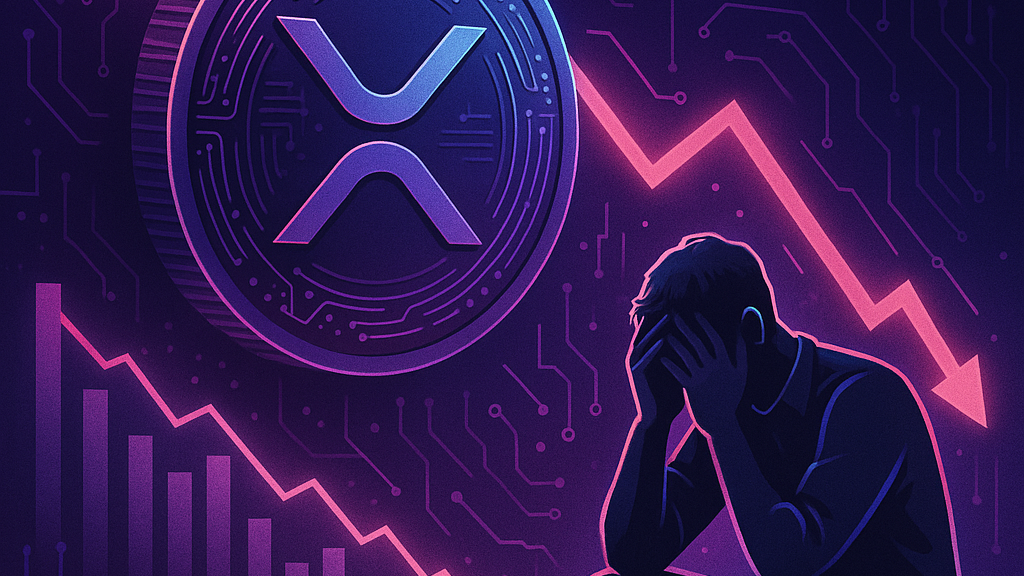
The ongoing price challenges facing XRP have escalated from typical market fluctuations to a more troubling situation, resembling capitulation. Investors who purchased XRP at prices exceeding $2 in the past year are now confronted with substantial losses, estimated to tally between $20 million and $110 million daily, as the cryptocurrency has plummeted approximately 55% over the last six months to around $1.30.
This current trend illustrates a shift in selling dynamics; the pressure on XRP is being largely driven by investors who are cutting their losses in response to ongoing market weaknesses rather than looking to capitalize on profits. This trend has created a market environment increasingly filled with apprehensive late buyers, while earlier investors who accumulated at lower prices still have the capacity to reduce their holdings.

It is important to note that XRP is currently facing one of its most extended losing streaks since 2014, which has resulted in a market structure that is quite precarious. As every small recovery in price occurs, it tends to attract sellers looking to exit their positions rather than new buyers, highlighting the vulnerability of the asset.
In contrast to previous cycles, where XRP holders would sell off their assets when prices rose, the current selling pattern demonstrates a phase of distribution during a market downturn. Observers of the cryptocurrency market have described this pattern as indicative of waning confidence in XRP’s short-term potential, which complicates efforts to reverse this selling trend.
Data from Santiment has revealed that wallets active on the XRP Ledger have experienced an average decline of about 41% in their positions, making it the lowest mean-to-realized value for XRP since the FTX collapse in November 2022. This data underscores the serious impacts of the current selloff and the struggles faced in mounting a sustainable recovery.
The broader cryptocurrency landscape has not provided relief either, as the downturn in XRP has coincided with a general risk-off sentiment in the market, which has seen Bitcoin’s price drop from over $126,000 to about $66,000. In such an environment, traders are increasingly reluctant to invest in assets that lack clear short-term catalysts, particularly when the behavior of current holders appears to be weakening.
Despite this challenging context, there is still evidence that some demand for XRP persists. Data from CryptoQuant indicates that the spot cumulative volume delta on Binance has reached approximately $520.2 million, suggesting that buyers are still entering the market. However, the perpetual cumulative volume delta remains negative at around $261 million, indicating that leveraged traders have not yet adjusted their positions to reflect any potential market shift.
This discrepancy illustrates the current state of XRP’s market, where an influx of cash-market demand exists, but the derivatives market is yet to exhibit the aggressive repositioning typically associated with stronger price movements. Although spot demand may provide some price stability, the lack of enthusiasm from futures traders results in insufficient momentum for any lasting recovery.
Alongside this, the behavior of large holders, or whales, also reveals a constrained market. Reports indicate that daily whale inflows into Binance have diminished to about 12.6 million XRP, with the cumulative flow over the past 30 days falling to around 1.44 billion XRP from approximately 2.6 billion XRP in March. This reduction suggests that while supply from prominent holders has eased, it does not automatically translate into demand.
The situation remains fluid, with XRP precariously positioned as it navigates both ongoing selling pressure and a lack of renewed buying enthusiasm from the market. Ripple, the company behind XRP, has seen some improvements in its operational landscape, particularly following a favorable settlement with the US Securities and Exchange Commission. These shifts could eventually bolster XRP’s long-term potential, but they have yet to translate into immediate market confidence.
Despite advances in legal clarity and institutional interest surrounding XRP, the cryptocurrency continues to be treated as a distressed asset, caught between the hopes of a favorable recovery and the reality of a market still dominated by cautious sentiment. This duality leaves XRP in an uncertain position, constrained by both past losses and a current landscape that has not fully embraced risk.
Leave the reaction
Sarah Chen










Commentaries
Add your comment
Fill in necessary fields and publish