


Decentralized Finance: Balancing Gas Efficiency and Market Stability
We have always followed the principles of transparency and clear information. Some of our content includes affiliate links, and we may earn a small commission through these partnerships. These partnerships do not influence our editorial independence or opinion. By using our site, you accept our privacy policy and terms and conditions.


James Mitchell combines investment banking with cryptocurrency journalism to analyze the institutional adoption of digital assets. Specializing in ETFs and regulation, he translates complex developments…
Cryptocurrency is a high-risk asset class, and investing carries significant risk, including the potential loss of some or all of your investment. The information on this website is provided for informational and educational purposes only and does not constitute financial, investment, or gambling advice. Cryptowinx does not endorse any specific exchange or gaming platform. For more details, please read our terms and full disclaimer.
Cryptowinx navigates the digital asset universe with a dynamic, forward-looking vision. Throughout our evolution, we have followed every market cycle, from vertical rises to corrections, always remaining a solid point of reference for our community. Our team is made up of industry experts and analysts who experience the blockchain ecosystem daily: we constantly monitor Bitcoin’s stability, study the expansion of the Ethereum ecosystem, and analyze the new frontiers of crypto casinos. We are committed to absolute editorial integrity, separating the signal from the noise through rigorous fact-checking and multi-perspective news analysis. In a landscape where innovations emerge in moments, our mission is to simplify complex concepts and offer transparency into what is established and what is still experimental.
Learn more Cryptowinx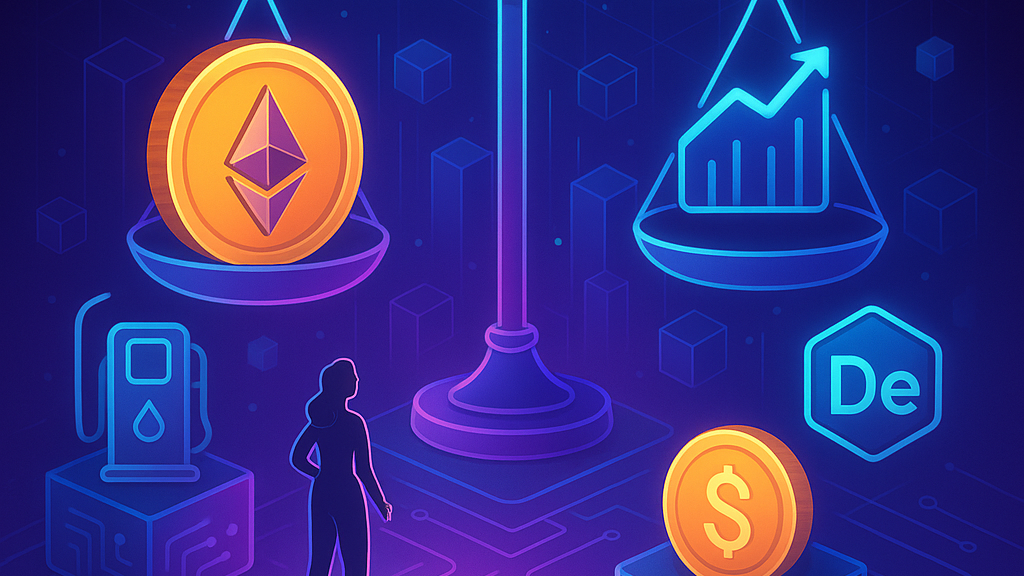
In the realm of decentralized finance (DeFi), the emphasis on gas fee efficiency is becoming a defining characteristic, overshadowing the need for strong market stability. This core focus on minimizing computational costs often results in a streamlined financial framework that falters under the weight of market volatility.
Experts argue that this trend, initially seen as a technical optimization, is beginning to significantly influence the potential of DeFi. The priority given to gas efficiency tends to undermine the robustness necessary to weather financial turbulence.

DeFi has successfully restructured traditional financial instruments, establishing exchanges, lending platforms, derivatives, and stablecoins. However, the underlying mechanics of these systems reveal a dependency on stable computational environments, which may not always be sufficient during critical market fluctuations.
Typically, risk parameters within these platforms remain unchanged for extended periods. While collateral thresholds can be modified, such changes are often slow and reliant on governance processes rather than being automatically updated. The reliance on fixed formulas for liquidation means that when market conditions shift dramatically, these systems struggle to adapt.
On blockchain platforms like Ethereum, the absence of advanced mathematical capabilities complicates the effort to continuously assess cross-asset exposure. This limitation leads to a reduction of financial strategies into more simplistic models that can be executed affordably but often lack the necessary nuance to respond to changing conditions.
While this design may work well under stable circumstances, history has shown that it can break down during periods of extreme volatility. For instance, MakerDAO witnessed severe liquidations during the market crash in March 2020, where collateral was sold at essentially zero bids due to congestion and price plummeting.
Similarly, in later downturns, systems such as Aave and Compound fell back on static collateral ratios during their responses to market changes, rather than employing dynamic adjustments that reflect the current risks. These incidents highlight that while the decentralized nature of these systems is maintained, they struggle to perform under stress due to rigid financial frameworks.
In contrast, traditional financial institutions have developed sophisticated risk management systems that simulate numerous scenarios, allowing them to adjust margin requirements dynamically. The advanced computational capabilities enable them to navigate market complexities effectively, a stark contrast to many DeFi protocols.
By simplifying their computational models, DeFi platforms may reduce certain risks, but this does not eliminate complexities within the overall financial ecosystem. When on-chain risk modeling becomes infeasible, analysis and adjustments often shift off-chain, resulting in opaque processes that can obscure decision-making.

Thus, while the blockchain remains the key settlement layer, the systems that ensure balance and adaptability increasingly operate outside its purview, particularly in times of market turbulence.
Initially, the move towards simplified financial logic in DeFi was driven by cost concerns rather than a proven superiority of fixed models. As markets evolve and interconnectedness increases, the limitations of these static approaches become more apparent, with potential risks amplifying rather than mitigating stress.
The primary bottleneck, therefore, may stem from the design of execution environments. If DeFi can evolve to include more sophisticated computational methods, it could allow for more accurate risk assessment models that better respond to market dynamics.
Innovation in this area could transform lending protocols, enabling them to integrate scenario-based testing for market stresses instead of relying exclusively on predetermined collateral ratios. This adaptability would ideally allow for a more transparent evaluation of multivariable risks, enhancing overall stability.
Critically, the financial integrity of DeFi may hinge on accepting computational complexity as a necessary component of robust financial design. By rethinking execution systems to support sophisticated calculations, DeFi could maintain visibility and accountability without sacrificing operational integrity.
Ultimately, DeFi stands at a pivotal juncture. The choice between maintaining a focus on gas-efficient simplicity or embracing complex execution capabilities will determine its ability to scale responsibly in a dynamic market landscape. If the field does not evolve its computational foundations, it risks building a structure that appears straightforward while operating under the constraints of a simplistic framework.
Leave the reaction
James Mitchell










Commentaries
Add your comment
Fill in necessary fields and publish