


US Legislation Aims to Bolster Domestic Bitcoin Mining Hardware
We have always followed the principles of transparency and clear information. Some of our content includes affiliate links, and we may earn a small commission through these partnerships. These partnerships do not influence our editorial independence or opinion. By using our site, you accept our privacy policy and terms and conditions.


A Web3 and NFT expert, Elena focuses on the evolution of digital art and blockchain gaming for CryptoWinx. She combines technical expertise with a deep…
Cryptocurrency is a high-risk asset class, and investing carries significant risk, including the potential loss of some or all of your investment. The information on this website is provided for informational and educational purposes only and does not constitute financial, investment, or gambling advice. Cryptowinx does not endorse any specific exchange or gaming platform. For more details, please read our terms and full disclaimer.
Cryptowinx navigates the digital asset universe with a dynamic, forward-looking vision. Throughout our evolution, we have followed every market cycle, from vertical rises to corrections, always remaining a solid point of reference for our community. Our team is made up of industry experts and analysts who experience the blockchain ecosystem daily: we constantly monitor Bitcoin’s stability, study the expansion of the Ethereum ecosystem, and analyze the new frontiers of crypto casinos. We are committed to absolute editorial integrity, separating the signal from the noise through rigorous fact-checking and multi-perspective news analysis. In a landscape where innovations emerge in moments, our mission is to simplify complex concepts and offer transparency into what is established and what is still experimental.
Learn more Cryptowinx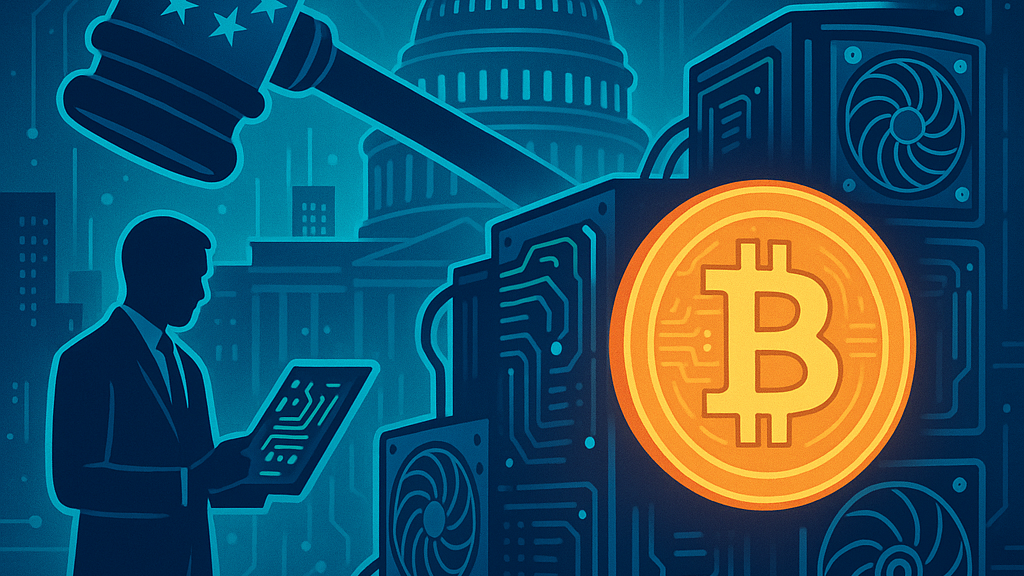
With the United States currently commanding approximately 38% of the global Bitcoin mining landscape, a significant challenge persists due to the nation’s reliance on Chinese manufacturers for specialized mining equipment. This dependence raises concerns over national industrial security, a gap that two U.S. Senators seek to address through new legislation.
On March 30, Senators Bill Cassidy and Cynthia Lummis unveiled the ‘Mined in America Act,’ aiming to mitigate the U.S. vulnerability stemming from foreign hardware reliance. This legislative initiative emphasizes the necessity of fostering domestic manufacturing, along with establishing a certification program for mining facilities.

Statistics indicate that around 97% of mining hardware utilized in the United States is sourced from China. Such a substantial reliance presents a precarious situation for American Bitcoin mining operations that are already under economic pressure. With current U.S. Bitcoin mining capabilities hovering between 37% and 38% of the worldwide total, valued at approximately 400 exahashes per second, the bill underscores a pressing need for domestic production.
The Mined in America Act proposes a voluntary certification process named ‘Mined in America,’ which will be administered by the Department of Commerce. This initiative aims to phase out mining equipment linked to foreign adversaries, thereby enhancing national security and self-sufficiency.
Additions to the bill include support for domestic manufacturing through existing federal energy and rural development programs. By codifying the Strategic Bitcoin Reserve, established by former President Donald Trump in March 2025, the legislation further secures federal backing for the Bitcoin sector, ensuring that any future acquisitions remain budget-neutral.
The introduction of this legislation is a direct response to previous federal actions where U.S. authorities began seizing Chinese-made mining equipment, highlighting the existing vulnerabilities in the supply chain. This enforcement not only illustrates the gravity of the situation but also provides tangible evidence for lawmakers advocating for a shift towards domestic sourcing.

As Bitcoin mining continues to be entwined with broader industrial policies, the Mined in America Act presents a strategic approach to positioning the U.S. favorably within this rapidly evolving landscape. By aligning Bitcoin mining with other critical infrastructure sectors like semiconductors, the legislation seeks to bolster American economic competitiveness while ensuring operational resilience.
In conclusion, this legislative push encapsulates a pivotal moment for U.S. Bitcoin mining, potentially reshaping the hardware procurement landscape by fostering local production. Should the bill gain traction, it could lead to a significant reduction in dependency on foreign suppliers while promoting the growth of an American-centric mining industry.
Leave the reaction
Elena Rodriguez








Commentaries
Add your comment
Fill in necessary fields and publish