


Market Turmoil: $414M Exits Shift Crypto Dynamics, XRP Thrives
We have always followed the principles of transparency and clear information. Some of our content includes affiliate links, and we may earn a small commission through these partnerships. These partnerships do not influence our editorial independence or opinion. By using our site, you accept our privacy policy and terms and conditions.


A Senior Altcoin Analyst, Sarah combines on-chain data with a background in venture capital research. With a Master’s in Computer Science, she provides precise evaluations…
Cryptocurrency is a high-risk asset class, and investing carries significant risk, including the potential loss of some or all of your investment. The information on this website is provided for informational and educational purposes only and does not constitute financial, investment, or gambling advice. Cryptowinx does not endorse any specific exchange or gaming platform. For more details, please read our terms and full disclaimer.
Cryptowinx navigates the digital asset universe with a dynamic, forward-looking vision. Throughout our evolution, we have followed every market cycle, from vertical rises to corrections, always remaining a solid point of reference for our community. Our team is made up of industry experts and analysts who experience the blockchain ecosystem daily: we constantly monitor Bitcoin’s stability, study the expansion of the Ethereum ecosystem, and analyze the new frontiers of crypto casinos. We are committed to absolute editorial integrity, separating the signal from the noise through rigorous fact-checking and multi-perspective news analysis. In a landscape where innovations emerge in moments, our mission is to simplify complex concepts and offer transparency into what is established and what is still experimental.
Learn more Cryptowinx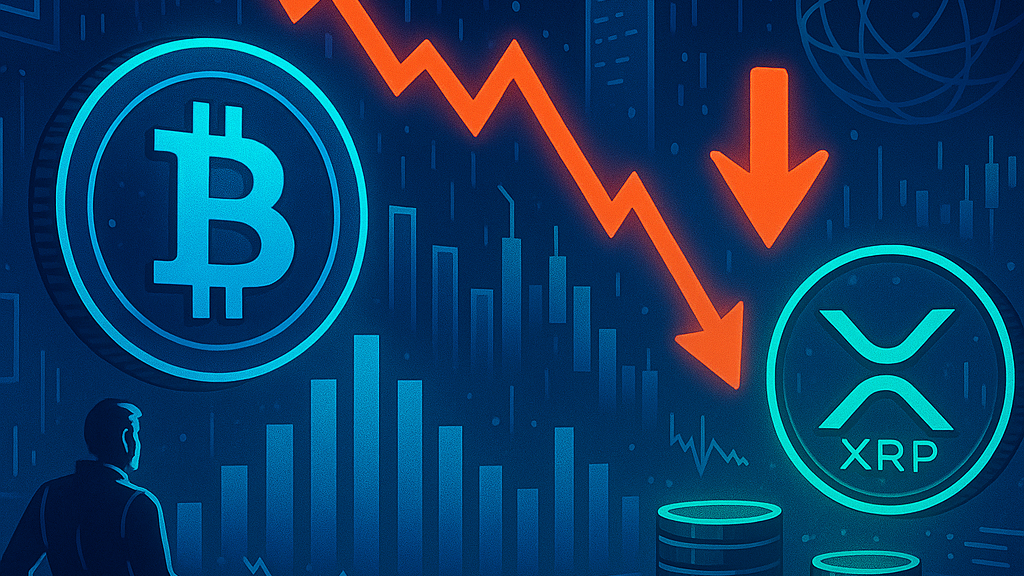
Recent market activity has highlighted a significant shift in investor sentiment within the digital asset landscape, as a staggering $414 million flowed out of investment products last week. This abrupt change follows five consecutive weeks of positive inflows, signaling a growing caution among investors amidst geopolitical tensions, particularly related to the Iran conflict, and rising inflation concerns, as reported by CoinShares.
In light of these developments, the overall assets under management (AuM) in digital asset products have plummeted to $129 billion, reverting to levels reminiscent of early February and April 2025, coinciding with significant political events like Trump’s tariff imposition.

The effects of this negative sentiment were most acutely felt by Ethereum, which saw an outflow of $222 million, likely influenced by the latest updates concerning the Clarity Act. This substantial withdrawal has resulted in Ethereum experiencing a net loss of $273 million year-to-date, marking it as the worst performer among digital assets. Bitcoin also faced challenges, with $194 million exiting during the same period, although it maintains a positive net position of $964 million for the year. Additionally, short-Bitcoin investment products attracted $4 million.
Other cryptocurrencies like Solana and Sui also reported reductions, with withdrawals of $12.3 million and $0.4 million respectively. Multi-asset products did not escape the trend, suffering an outflow of $4.4 million. In stark contrast, XRP emerged as a beacon of strength, pulling in $15.8 million, with Chainlink and Stellar each managing modest gains of $0.2 million.
A geographical analysis of these movements reveals a pronounced trend, especially in the United States, where digital asset products experienced a dramatic withdrawal of $445 million. Other countries like Switzerland, Sweden, and Hong Kong also saw reductions, albeit on a smaller scale. Conversely, Germany and Canada capitalized on the market dip, recording positive inflows of $21.2 million and $15.9 million respectively. Brazil also noted a minor gain, attracting an additional $2.6 million.
The shift in investor flows aligns with Bitcoin’s recent stability challenges. According to insights from QCP Capital, Bitcoin seems poised to remain in a range-bound state, likely oscillating between $65,000 and $70,000. This range has been characterized by patterns of weekend dips followed by recovery at the onset of the week. Despite its ability to outperform gold and major equities in the face of ongoing geopolitical issues related to Iran, the general sentiment remains precarious.

Bitcoin is currently facing the prospect of a sixth consecutive monthly decline and its first three-month losing streak of the year. QCP Capital noted that a stronger conviction among investors will be essential to spark any significant upside, especially in light of recent selling pressures following quarterly options expiration. The firm anticipates Bitcoin to remain largely stable until early April, when crucial developments regarding potential military actions against Iran could unfold.
In summary, the current market dynamics underscore rising geopolitical risks and sustained high oil prices, which could further exacerbate inflation and impact Bitcoin’s attractiveness as a non-sovereign store of value in the long run.
Leave the reaction
Sarah Chen












Commentaries
Add your comment
Fill in necessary fields and publish