


Market Turmoil: Crypto Prices Fall Amid Hormuz Tensions
We have always followed the principles of transparency and clear information. Some of our content includes affiliate links, and we may earn a small commission through these partnerships. These partnerships do not influence our editorial independence or opinion. By using our site, you accept our privacy policy and terms and conditions.


A Web3 and NFT expert, Elena focuses on the evolution of digital art and blockchain gaming for CryptoWinx. She combines technical expertise with a deep…
Cryptocurrency is a high-risk asset class, and investing carries significant risk, including the potential loss of some or all of your investment. The information on this website is provided for informational and educational purposes only and does not constitute financial, investment, or gambling advice. Cryptowinx does not endorse any specific exchange or gaming platform. For more details, please read our terms and full disclaimer.
Cryptowinx navigates the digital asset universe with a dynamic, forward-looking vision. Throughout our evolution, we have followed every market cycle, from vertical rises to corrections, always remaining a solid point of reference for our community. Our team is made up of industry experts and analysts who experience the blockchain ecosystem daily: we constantly monitor Bitcoin’s stability, study the expansion of the Ethereum ecosystem, and analyze the new frontiers of crypto casinos. We are committed to absolute editorial integrity, separating the signal from the noise through rigorous fact-checking and multi-perspective news analysis. In a landscape where innovations emerge in moments, our mission is to simplify complex concepts and offer transparency into what is established and what is still experimental.
Learn more Cryptowinx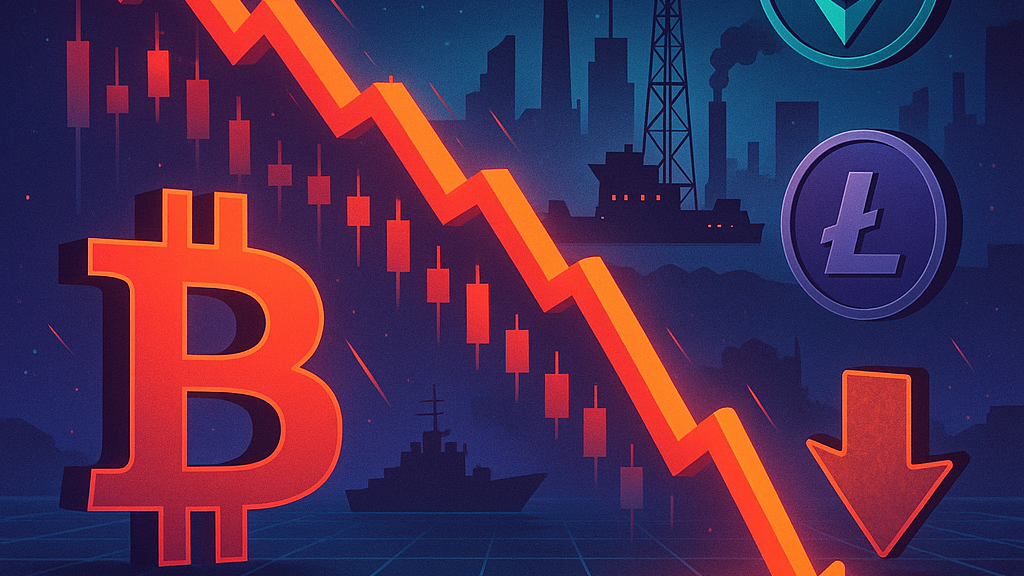
The ongoing geopolitical tensions in the Middle East have led to a notable decline in the prices of major cryptocurrencies, Bitcoin and Ethereum. As Iran tightens its grip on the Strait of Hormuz, traders express concerns about potential disruptions in oil shipping routes, which have a ripple effect on global financial markets.
Recent reports indicate that two container vessels, linked to China’s state-owned Cosco Shipping, diverted their course away from the Hormuz region after passing near Iranian waters. This shift raises alarm about Iran’s increasing enforcement of maritime controls, particularly against ships associated with countries considered adversaries.

According to observations, the CSCL Indian Ocean and CSCL Arctic Ocean turned back after nearing the strategic narrow entrance to the Strait of Hormuz. The Iranian Revolutionary Guard has emphasized its position, stating that any vessels tied to the United States and Israel would be barred from passing through these waters.
In a broader context, analysts suggest that Iran has adopted a de facto regulatory approach over vessel movements in the Hormuz Strait. This includes requiring certain ships to navigate through routes designated by Iran or to obtain prior approval before making their passage. Such actions not only impact shipping traffic but also heighten overall energy security concerns.
On the financial front, cryptocurrencies reacted swiftly to these developments. Bitcoin, which stood at approximately $66,619, experienced a decline of around 4%, while Ethereum slipped by about 3.9%, trading near $1,990. The factors contributing to these downturns are largely attributed to the renewed uncertainties stemming from the rapidly escalating situation in the Middle East.
Additionally, some unverified social media reports claimed that Iran had targeted another tanker in the Strait, although established news sources have refrained from confirming this assertion. Such rumors only add to the market’s instability.

In response to these developments, the UAE has reportedly shown openness to the idea of supporting an international coalition aimed at ensuring the security of shipping routes in the Strait, a critical chokepoint for global oil supplies.
As the situation unfolds, the implications for both regional stability and the broader economic landscape remain significant. The interplay between geopolitical tensions and financial markets underscores the fragility of investor sentiment, particularly within the volatile cryptocurrency sector.
Leave the reaction
Elena Rodriguez








Commentaries
Add your comment
Fill in necessary fields and publish