


Bitcoin Mining Faces Challenges Amid Falling Hashrate
We have always followed the principles of transparency and clear information. Some of our content includes affiliate links, and we may earn a small commission through these partnerships. These partnerships do not influence our editorial independence or opinion. By using our site, you accept our privacy policy and terms and conditions.


A crypto casino and gaming specialist, Raj brings a digital native’s perspective to industry trends and provably fair systems. Having reviewed over 150 platforms, he…
Cryptocurrency is a high-risk asset class, and investing carries significant risk, including the potential loss of some or all of your investment. The information on this website is provided for informational and educational purposes only and does not constitute financial, investment, or gambling advice. Cryptowinx does not endorse any specific exchange or gaming platform. For more details, please read our terms and full disclaimer.
Cryptowinx navigates the digital asset universe with a dynamic, forward-looking vision. Throughout our evolution, we have followed every market cycle, from vertical rises to corrections, always remaining a solid point of reference for our community. Our team is made up of industry experts and analysts who experience the blockchain ecosystem daily: we constantly monitor Bitcoin’s stability, study the expansion of the Ethereum ecosystem, and analyze the new frontiers of crypto casinos. We are committed to absolute editorial integrity, separating the signal from the noise through rigorous fact-checking and multi-perspective news analysis. In a landscape where innovations emerge in moments, our mission is to simplify complex concepts and offer transparency into what is established and what is still experimental.
Learn more Cryptowinx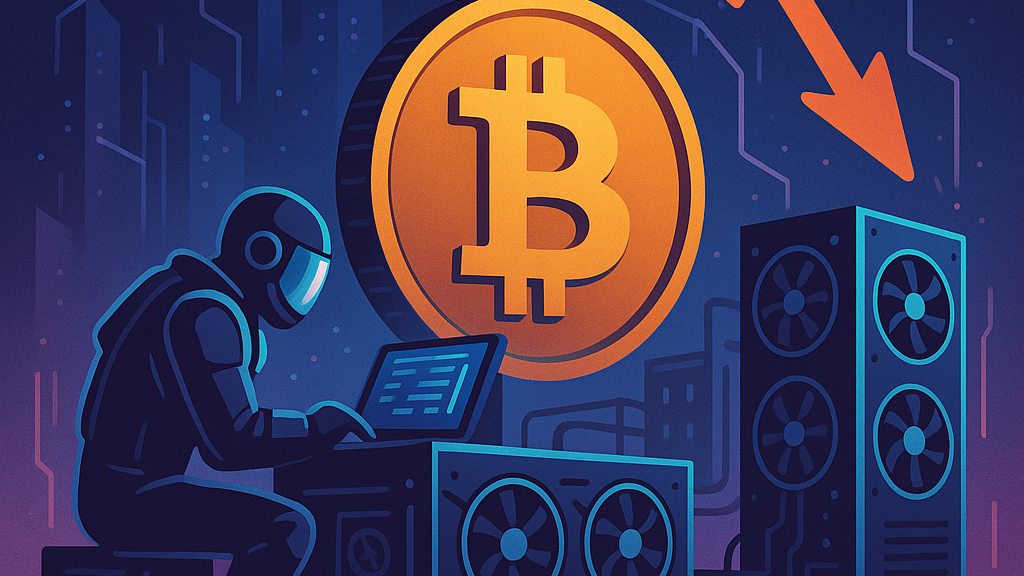
The Bitcoin mining landscape is currently experiencing a notable downturn as the network’s hashrate has dipped below the significant threshold of one zettahash. This development comes amid ongoing concerns regarding miner profitability, which continues to be fragile.
Recent statistics reveal that the hashrate, a crucial measure of the processing power devoted to Bitcoin mining, has fallen below the critical level of 1 zettahash. This decline suggests that fewer miners are engaging in Bitcoin mining activities, likely due to reduced financial returns.

According to industry insights, the revenue generated by miners remains under pressure. The economic context surrounding Bitcoin mining has shifted, leading to a situation where many miners are finding it increasingly challenging to maintain operations. Factors such as electricity costs, hardware efficiency, and the current market value of Bitcoin itself play a crucial role in this dynamic.
Miners reportedly have expressed concerns about the sustainability of their operations in light of these challenges. With an environment marked by lower mining rewards and heightened competition, many are reevaluating their strategies to ensure they can continue participating in the market.
The current situation illustrates the complex nature of the cryptocurrency mining industry, where external conditions can have a profound impact on the ability of miners to remain profitable. The intertwining factors of market prices and operational costs mean that any fluctuations can significantly influence miner decisions.

As the industry adapts to these new realities, it will be essential for stakeholders to monitor changes in hashrate trends. Understanding these developments can provide valuable insight into the future of Bitcoin mining, which remains a cornerstone of the cryptocurrency ecosystem.
In conclusion, the decline in Bitcoin’s hashrate below the zettahash mark, coupled with thin miner revenues, highlights a pivotal moment for the mining sector. With the challenges ahead, both individual miners and the broader industry must navigate this shifting landscape carefully.
Leave the reaction
Raj Patel












Commentaries
Add your comment
Fill in necessary fields and publish