


Divergent Responses: Bitcoin vs Gold Amid Iran Crisis
We have always followed the principles of transparency and clear information. Some of our content includes affiliate links, and we may earn a small commission through these partnerships. These partnerships do not influence our editorial independence or opinion. By using our site, you accept our privacy policy and terms and conditions.


A presale and tokenomics specialist, Sofia evaluates new crypto projects with the analytical rigor of her Bocconi background. Having reviewed over 200 launches, she excels…
Cryptocurrency is a high-risk asset class, and investing carries significant risk, including the potential loss of some or all of your investment. The information on this website is provided for informational and educational purposes only and does not constitute financial, investment, or gambling advice. Cryptowinx does not endorse any specific exchange or gaming platform. For more details, please read our terms and full disclaimer.
Cryptowinx navigates the digital asset universe with a dynamic, forward-looking vision. Throughout our evolution, we have followed every market cycle, from vertical rises to corrections, always remaining a solid point of reference for our community. Our team is made up of industry experts and analysts who experience the blockchain ecosystem daily: we constantly monitor Bitcoin’s stability, study the expansion of the Ethereum ecosystem, and analyze the new frontiers of crypto casinos. We are committed to absolute editorial integrity, separating the signal from the noise through rigorous fact-checking and multi-perspective news analysis. In a landscape where innovations emerge in moments, our mission is to simplify complex concepts and offer transparency into what is established and what is still experimental.
Learn more Cryptowinx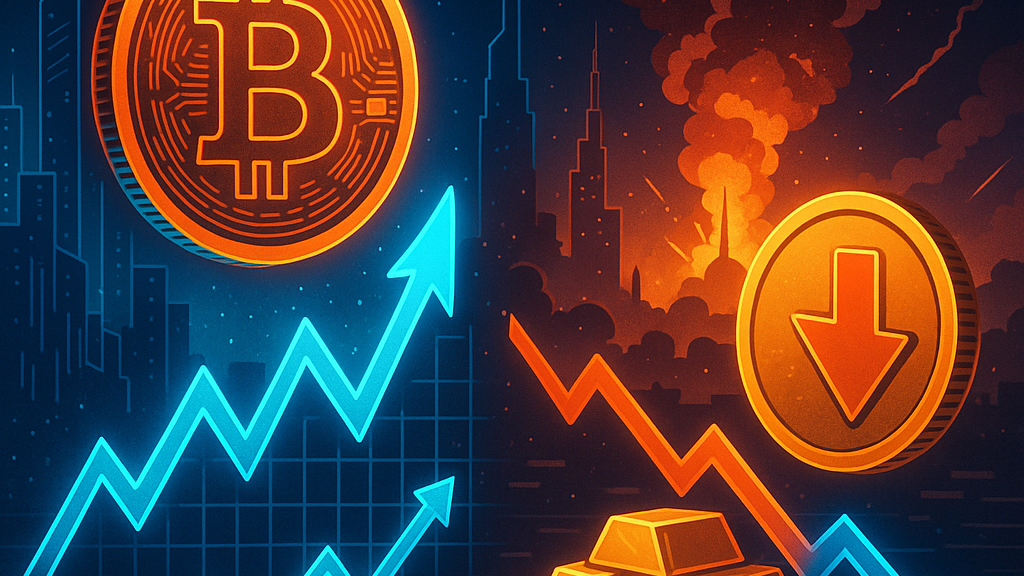
The recent conflict in Iran has prompted significant fluctuations in financial markets, showcasing how different assets react under pressure. As the situation unfolded, investors turned to various stores of value, revealing intricate dynamics between traditional safe-haven investments like gold and emerging digital alternatives such as Bitcoin.
The 2026 geopolitical tensions stirred global financial uncertainty, impacting market patterns and asset flows. Gold initially experienced an influx of buying, as is customary during crises; however, this trend was short-lived. Despite its reputation as a safe-haven asset, gold’s prices dipped due to a strengthening US dollar and increasing Treasury yields, indicating that macroeconomic factors can sometimes overshadow immediate safe-haven demand.

In contrast, Bitcoin displayed a unique market behavior. Following the onset of the conflict, the cryptocurrency experienced initial volatility, with traders quickly adjusting their risk exposure. Nevertheless, it rebounded swiftly, demonstrating the growing appeal of Bitcoin among investors seeking alternatives in times of uncertainty.
During the initial stages of the Iran crisis, financial markets were rattled, leading to sharp increases in oil prices and a risk-averse sentiment across the board. As stock indices dipped globally, the usual pattern of flocking to gold was complicated; many investors opted for liquidity, selling off gold in favor of cash as they navigated the tumultuous climate.
Although gold’s appeal as a safe-haven asset remains, the dynamic landscape of modern finance seems to challenge its traditional status. During the crisis, while gold’s demand surged initially, the subsequent decline highlighted the short-term vulnerabilities of established commodities when investors prioritize immediate liquidity over holding physical assets.
Bitcoin’s performance, on the other hand, underscores its status as a potential hedge in volatile times, albeit with a distinct twist. Its recovery following the initial price drop indicates that some investors are recognizing its value amidst global uncertainty. Indeed, Bitcoin’s journey through this crisis reflects the changing tastes among investors regarding risk and opportunity.

Throughout this incident, the strength of the US dollar emerged as a critical factor influencing both gold and Bitcoin. With the dollar’s ascent, the attractiveness of gold diminished as it becomes more expensive for those using other currencies. Bitcoin is no stranger to these dynamics, as the cryptocurrency market also reacts to shifts in dollar strength. The interplay between liquidity preferences and the surrounding economic conditions has created an intricate web affecting both asset classes.
This scenario emphasizes the contrasting paths of gold and Bitcoin during times of geopolitical strife. While gold remains a steadfast entity with a long history as a reliable store of value, Bitcoin’s identity as a fluid alternative is still forming, especially in the context of global financial events.
The recent events surrounding the Iran crisis serve as a real-life trial for the narrative of Bitcoin as ‘digital gold’. Despite exhibiting resilience, Bitcoin has not yet established itself as a definitive safe-haven asset. Its fluctuating nature amidst investor sentiment and market liquidity positions it uniquely compared to the more stable and historically entrenched gold. As both assets navigate these turbulent waters, the evolving landscape suggests a shift in how investors perceive safety and value in their portfolios.
Leave the reaction
Sofia Russo










Commentaries
Add your comment
Fill in necessary fields and publish