


Market Reactions to the Iran Conflict: Bitcoin vs. Gold
We have always followed the principles of transparency and clear information. Some of our content includes affiliate links, and we may earn a small commission through these partnerships. These partnerships do not influence our editorial independence or opinion. By using our site, you accept our privacy policy and terms and conditions.


Financial services expert with over three years of experience monitoring cryptocurrency markets and blockchain innovation. Passionate about digital assets and the decentralized future.
Cryptocurrency is a high-risk asset class, and investing carries significant risk, including the potential loss of some or all of your investment. The information on this website is provided for informational and educational purposes only and does not constitute financial, investment, or gambling advice. Cryptowinx does not endorse any specific exchange or gaming platform. For more details, please read our terms and full disclaimer.
Cryptowinx navigates the digital asset universe with a dynamic, forward-looking vision. Throughout our evolution, we have followed every market cycle, from vertical rises to corrections, always remaining a solid point of reference for our community. Our team is made up of industry experts and analysts who experience the blockchain ecosystem daily: we constantly monitor Bitcoin’s stability, study the expansion of the Ethereum ecosystem, and analyze the new frontiers of crypto casinos. We are committed to absolute editorial integrity, separating the signal from the noise through rigorous fact-checking and multi-perspective news analysis. In a landscape where innovations emerge in moments, our mission is to simplify complex concepts and offer transparency into what is established and what is still experimental.
Learn more Cryptowinx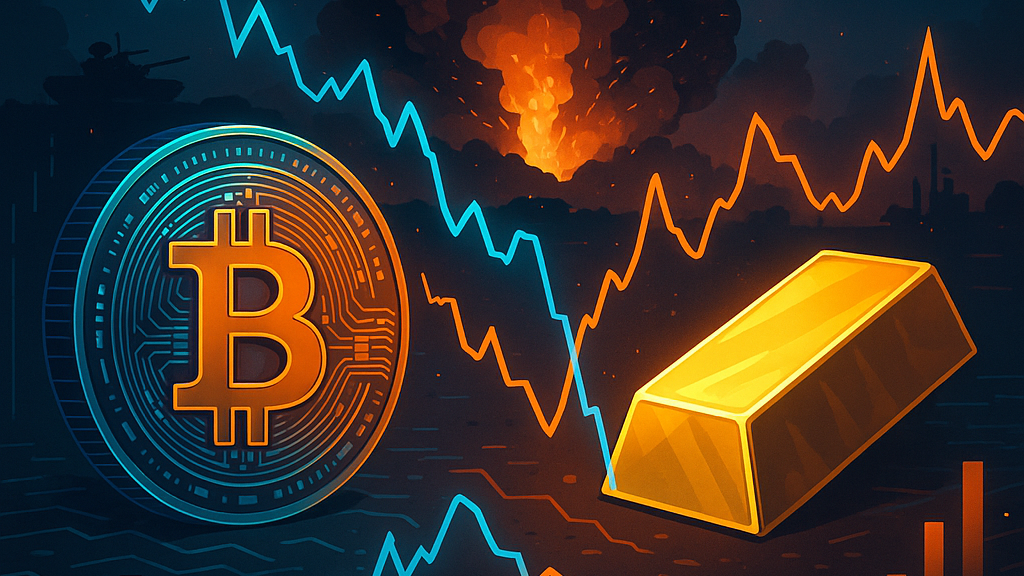
The recent conflict involving Iran has led to noteworthy shifts in the financial markets, particularly highlighted by the contrasting behaviors of gold and Bitcoin. While traditional investors flocked to gold seeking security, Bitcoin displayed a unique trajectory influenced by market liquidity and sentiment.
Amid the turbulence of the 2026 Iran conflict, global markets experienced significant upheaval. Investors were compelled to reconsider their positions on traditional assets like gold while also assessing the viability of Bitcoin as an alternative investment. The uncertain geopolitical landscape created a backdrop for these assets to react differently to the same crisis.

Initially, gold garnered attention as investors sought refuge in a well-established safe-haven asset. Prices increased as the situation escalated, reflecting traditional market behavior during crises. However, the anticipated safety of gold did not last indefinitely. As the US dollar gained strength and bond yields rose, gold prices subsequently fell, demonstrating that external economic forces can quickly override safe-haven buying.
In stark contrast, Bitcoin’s performance during these tumultuous times was characterized by sharp price fluctuations followed by recovery. On February 28, 2026, Bitcoin hit a low of $63,106 but managed to bounce back to $73,156 by March 5, indicating a resilient, albeit volatile, response to the market conditions created by the conflict. This movement suggests that Bitcoin’s investors may be looking towards it as a modern alternative hedge against instability.
Throughout history, investors have gravitated towards assets perceived as reliable during turmoil. Yet the dynamics at play during the Iran conflict were intricate. Investor actions reflected a desperate need for liquidity, which saw many selling off gold and other assets. Such behavior can be attributed to a preference for immediate cash in times of crisis as concerns over inflation and rising bond yields further complicated decisions, impacting both gold and Bitcoin.
The strength of the US dollar significantly influenced the market performance of both commodities. As the dollar increased in desirability, it placed downward pressure on gold prices due to its dollar-denominated nature. Conversely, Bitcoin’s price movements remained responsive to overall market sentiments rather than solely geopolitical concerns, highlighting its evolving status in the investment space.

Moreover, while gold has a long-standing history as a safe asset, Bitcoin is still navigating its identity within the financial ecosystem. The crisis underscored the divergence between established assets and emerging alternatives, raising critical questions about their respective roles in the context of investor security.
In conclusion, the conflict in Iran offered a real-world examination of Bitcoin’s potential as a safe-haven asset against the backdrop of traditional gold. While Bitcoin has emerged as a contender within the investment arena, its volatility suggests it has yet to fully realize the stable status of gold in times of uncertainty. The differing reactions of these assets during the Iran conflict serve to illuminate the ongoing evolution of investor behavior and their shifting perspectives on value preservation.
Leave the reaction
Gregory Russell










Commentaries
Add your comment
Fill in necessary fields and publish