


USDC Market Cap Approaches $80B Amid UAE Economic Shifts
We have always followed the principles of transparency and clear information. Some of our content includes affiliate links, and we may earn a small commission through these partnerships. These partnerships do not influence our editorial independence or opinion. By using our site, you accept our privacy policy and terms and conditions.


A presale and tokenomics specialist, Sofia evaluates new crypto projects with the analytical rigor of her Bocconi background. Having reviewed over 200 launches, she excels…
Cryptocurrency is a high-risk asset class, and investing carries significant risk, including the potential loss of some or all of your investment. The information on this website is provided for informational and educational purposes only and does not constitute financial, investment, or gambling advice. Cryptowinx does not endorse any specific exchange or gaming platform. For more details, please read our terms and full disclaimer.
Cryptowinx navigates the digital asset universe with a dynamic, forward-looking vision. Throughout our evolution, we have followed every market cycle, from vertical rises to corrections, always remaining a solid point of reference for our community. Our team is made up of industry experts and analysts who experience the blockchain ecosystem daily: we constantly monitor Bitcoin’s stability, study the expansion of the Ethereum ecosystem, and analyze the new frontiers of crypto casinos. We are committed to absolute editorial integrity, separating the signal from the noise through rigorous fact-checking and multi-perspective news analysis. In a landscape where innovations emerge in moments, our mission is to simplify complex concepts and offer transparency into what is established and what is still experimental.
Learn more Cryptowinx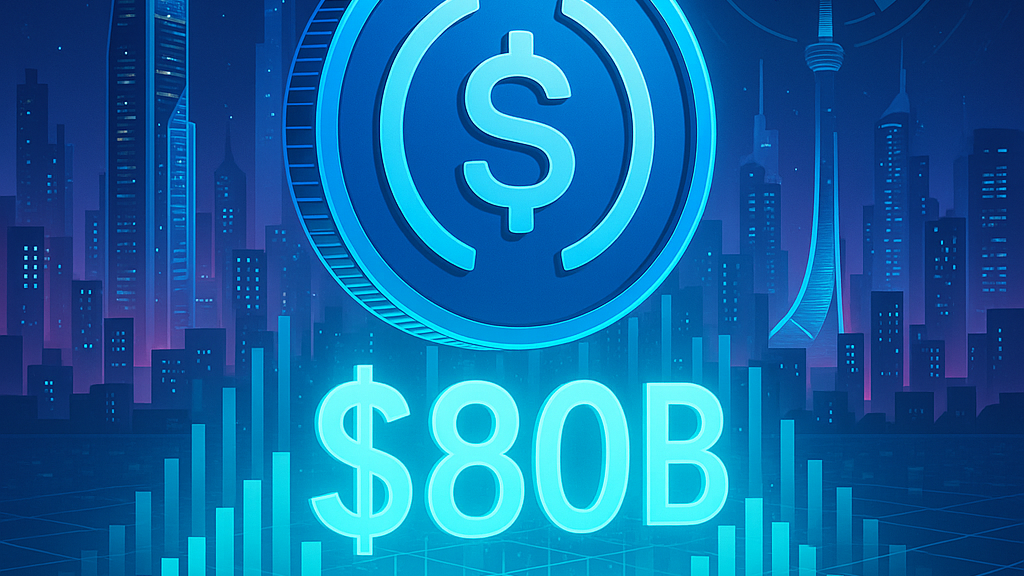
The USDC stablecoin is nearing a remarkable market capitalization of $80 billion, driven by increasing demand in the Middle East, particularly as investors react to economic instability in the United Arab Emirates.
Data from CoinMarketCap indicates that the circulating supply of USDC has surged to approximately $79.2 billion, setting a new record for this dollar-pegged coin. Previously, the stablecoin reached just below $79 billion in December of the previous year.

This surge in market cap follows a significant expansion of its supply, which has seen billions added in just a few weeks. The figures illustrate that USDC’s market cap increased from just over $70 billion in early February to $75 billion earlier this month.
Rami Al-Hashimi, a Dubai-based analyst, connected this rising demand for USDC to capital flight as investors look to withdraw funds from conventional markets. According to Al-Hashimi, over-the-counter (OTC) trading desks in Dubai are currently overwhelmed by the demand for this stablecoin.
He also pointed to recent declines in the UAE’s real estate market, claiming that property prices in Dubai have dropped by about 27% this month. This downturn has prompted a swift movement by investors seeking to transition their capital into digital assets.
Al-Hashimi described the current environment as one of significant investor anxiety, marked by phrases such as “War panic” and “Sellers are bleeding,” which reflect a drastic change in market dynamics.
Supporting this analysis, data from TradingView shows a significant downturn in the DFM Real Estate Index, which tracks the performance of publicly traded real estate and construction entities in Dubai. The index has plummeted from a recent peak of around 16,800 to approximately 11,516, which equates to a loss of about 31%.
This challenging market environment has led some property sellers to explore accepting cryptocurrency payments, with some listings reportedly offering discounts of 5–10% for transactions made in Bitcoin (BTC).
Furthermore, a recent report from Japanese investment bank Mizuho detailed that for the first time since 2019, USDC has overtaken Tether’s USDt (USDT) in terms of adjusted transaction volume. Year-to-date, USDC has recorded about $2.2 trillion in transactions, compared to USDt’s $1.3 trillion, giving USDC approximately 64% of the total market share in terms of adjusted transaction volume.
Despite this impressive shift in transaction activity, USDt maintains its position as the leading stablecoin by market capitalization, standing at around $184 billion, well ahead of USDC’s near $80 billion.
The rapid evolution of the USDC market illustrates how external economic pressures can accelerate shifts toward digital assets, particularly amid growing uncertainty in traditional financial arenas.
Leave the reaction
Sofia Russo












Commentaries
Add your comment
Fill in necessary fields and publish